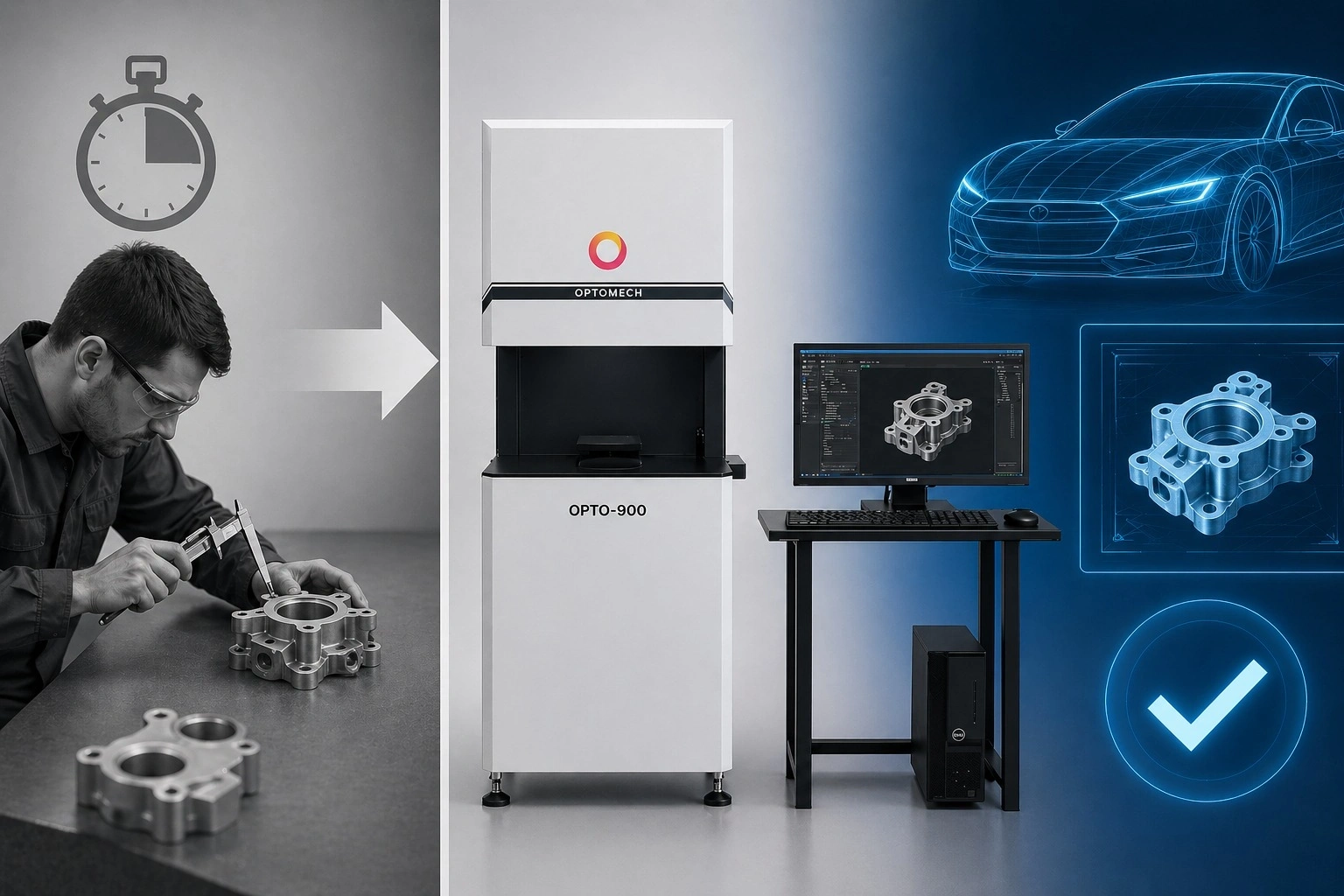
1,200+ part numbers inspected in under 30 seconds each. Gauge R&R from 24% to 8%. SPC data flowing live to plant ERP.
A leading manufacturer of precision turned components for the Indian automotive and EV supply chain was struggling to keep pace with rising inspection demands. With over 1,200 part numbers — shafts, bushings, pins, and aluminium extrusions — their quality team relied on manual micrometers, vernier calipers, and optical comparators. Each part required 8–12 individual measurements, taking 4 to 6 minutes per component. As OEM requirements tightened to ±10 µm tolerances, inspection became the production bottleneck. Gauge R&R studies were marginal at 24%, and there was no SPC data export to the plant ERP. An estimated 18% of finished parts were held for re-inspection due to inconsistent first-pass results.
After a live demonstration, the customer installed the Optomech Opto QMM-900 — a non-contact, template-based inspection system with double telecentric optics, a 20 MP CMOS sensor, and ±5 µm measurement accuracy. The system measures up to 22 features per part in a single scan in under 8 seconds. All dimensional data is logged to an onboard SQL database and exported via LAN to the plant MES/ERP for live SPC trending. The Optomech applications team loaded 5 part templates in a structured two-day programming session. 340 active part programs are now in use — new programs are added in under 5 minutes.
| Metric | Result |
|---|---|
| Inspection cycle time | 4–6 min per part → under 30 seconds (80% reduction) |
| Features per scan | 22 dimensions in a single automated pass |
| Measurement accuracy | ±5 µm — confirmed against NABL-calibrated masters |
| Gauge R&R | Improved from 24% to 8% — within automotive GR&R specification |
| Part hold / re-inspection rate | Reduced from 18% to 2.4% in first 90 days |
| SPC data export | Live CPK and Xbar-R data now flowing to plant ERP system |
| Templates loaded | 340 active part programs — new programs added in < 5 min |
| Operator training | Full competency in 2 days with no prior metrology training |
"We used to have three experienced inspectors tied up full-time just on dimensional checks. Now one operator runs the QMM and handles three times the volume. The SPC data going into our MES has transformed how our production team responds to drift. We should have done this three years ago."
Contact our metrology specialists to discuss how the Opto QMM-900 can reduce your inspection time and improve your quality metrics.
Chat with Us on WhatsApp Explore QMM Products →