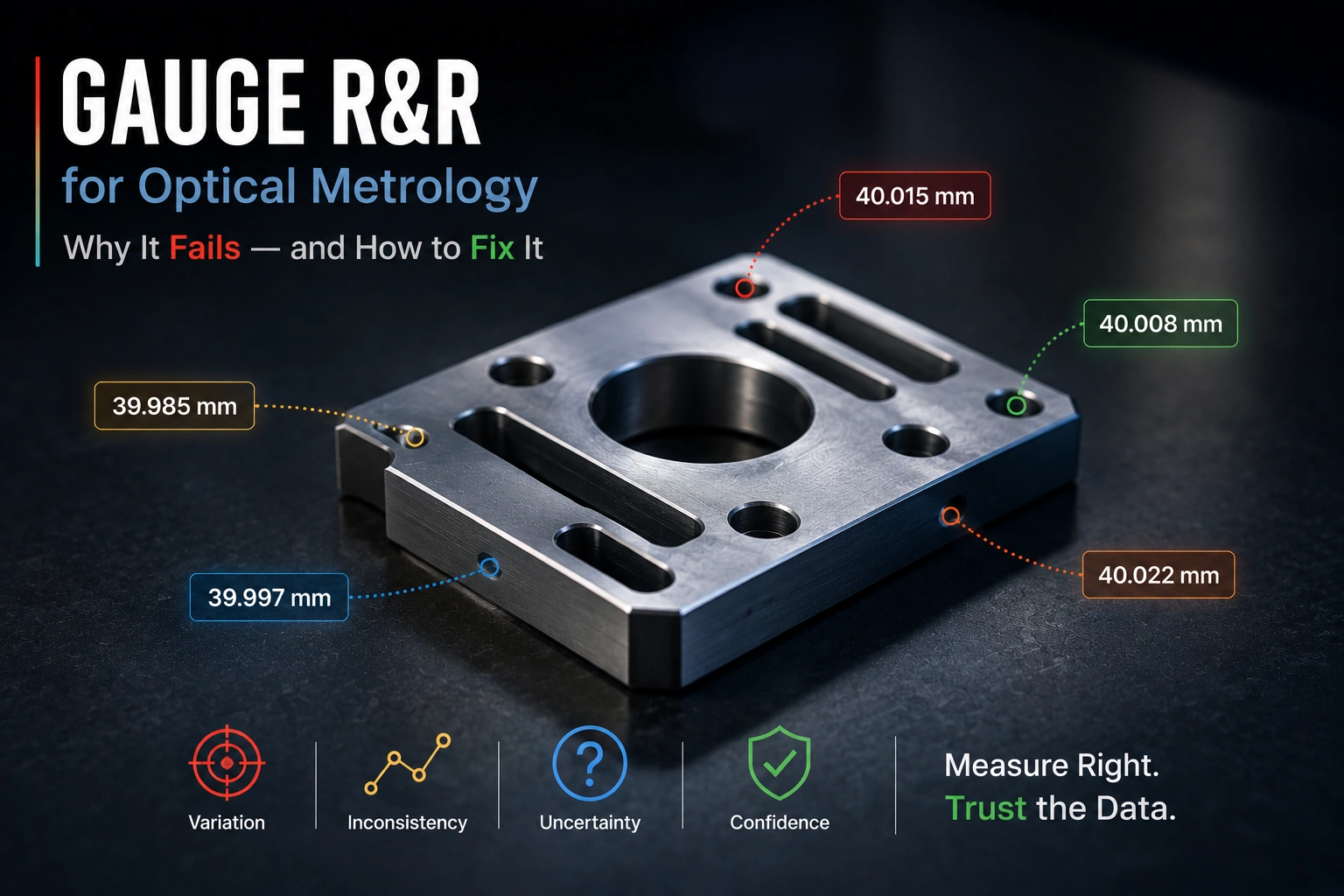
Gauge R&R (Gauge Repeatability and Reproducibility) is the standard method for evaluating whether a measurement system is capable enough to control a process. Per AIAG MSA guidelines, a gauge study result above 30% is unacceptable for production use. Between 10–30% is marginal. Below 10% is acceptable.
Here is what most QA teams don't realise: optical gauges — profile projectors, QMMs, VMMs — are inherently more capable than their gauge studies suggest, when those studies are conducted without accounting for the specific factors that drive variation in optical measurement. The instrument accuracy of ±2–5 µm is real. But the gauge study often returns 25–35% — and both numbers can be true simultaneously.
What Gauge R&R Actually Measures
A standard AIAG Gauge R&R (crossed study) measures two sources of variation:
- Repeatability (EV — Equipment Variation): variation from the gauge itself when the same operator measures the same part multiple times
- Reproducibility (AV — Appraiser Variation): variation between different operators measuring the same part with the same gauge
The total Gauge R&R (GRR%) is expressed as a percentage of the tolerance band. The formula is: GRR% = (5.15 × σ_gauge) / Tolerance × 100.
For optical gauges, AV — appraiser variation — is almost always the dominant contributor. And appraiser variation in optical measurement has very different root causes than in tactile gauging.
Why Optical Gauge R&R Studies Fail
Optical gauge R&R fails for predictable reasons. Understanding these is the first step to fixing them without replacing your instrument.
Manual Part Positioning Variation
When operators manually position parts on a profile projector or QMM stage without fixtures, part angle, overhang, and contact surface all vary between setups. Even a 0.5° angular error on a 10 mm part introduces 87 µm of apparent diameter error. This is appraiser variation — not instrument error.
Manual Overlay Alignment
Profile projectors with manual overlay charts require the operator to visually align the projected silhouette against the master overlay. Operator-to-operator variation in this alignment — especially at corners, radii, and thread roots — introduces 15–40 µm of appraiser variation even on instruments accurate to ±2 µm.
Part Surface Condition
Burrs, chips, coolant film, and surface finish variation change where the optical edge is detected. A freshly deburred part and an unprocessed part from the same batch can show 8–15 µm variation in OD on identical equipment — this appears as repeatability error, not instrument error.
Illumination Inconsistency
Profile projectors with aging bulbs or inconsistent aperture settings produce varying edge sharpness between measurement sessions. This affects where the edge-detection threshold places the measurement boundary — typically adding 5–10 µm of EV to a gauge study.
Thermal Expansion Between Readings
In a shop floor environment, metal parts thermally expand during handling. A steel shaft at 28°C vs 23°C shows ~5.5 µm diameter difference at 50 mm OD. If operators handle parts differently between repeat measurements, thermal variation shows up as repeatability error — wrongly attributed to the gauge.
Inappropriate Sample Selection
AIAG MSA requires 10 parts spanning the expected process range. If all 10 parts are from a tight batch within 5 µm of each other, the part-to-part variation (PV) is compressed — and GRR% inflates mathematically even if the gauge is perfectly capable. This is a study design error, not a gauge problem.
The Gauge R&R Acceptance Criteria — What the Numbers Mean
| GRR% Result | AIAG Classification | What It Means in Practice | Action Required |
|---|---|---|---|
| Below 10% | Acceptable | Gauge variation is less than 10% of the tolerance. System is measurement-capable. | None — continue use |
| 10–30% | Marginal | Gauge may be acceptable based on application importance, cost of repair, etc. Requires justification. | Document decision; investigate improvement |
| Above 30% | Not Acceptable | Gauge variation consumes more than 30% of tolerance. Measurement decisions are unreliable. | Identify and fix root cause before production use |
A pharmaceutical packaging QA manager in Hyderabad ran a gauge study on their PP 300TE profile projector. Initial result: 31% — "not acceptable." Root cause investigation: operators were using three different overlay alignment procedures. After standardising the alignment procedure and adding V-block fixturing, the same instrument returned 6.8% — well within acceptable limits. The instrument was never the problem.
How to Conduct a Valid Gauge R&R for Optical Instruments
The standard AIAG crossed Gauge R&R protocol works for optical instruments — but requires specific adaptations to avoid inflating the result with controllable sources of variation.
-
Select parts that span the process range Choose 10 parts that span at least 80% of the expected process variation — not 10 parts from the same batch. If your process produces parts from -15 µm to +15 µm of nominal, your 10 study parts should cover that full range. Compressed part selection is the most common study design error.
-
Establish and document a fixturing standard before the study Every operator must load each part identically. For profile projectors: use V-blocks, magnetic stages, or custom fixtures. For QMMs: use the pre-loaded CNC part program with standardised nest. Run a repeatability pre-check: one operator, one part, 10 consecutive measurements — if EV is above 5 µm, fix the fixturing before running the full study.
-
Standardise the measurement program before appraiser variation testing For CNC optical instruments (VMM, QMM), pre-load the measurement program and lock it. All three appraisers run the same program — no manual feature selection. For profile projectors: standardise the overlay, lamp intensity, aperture setting, and focus procedure in a written work instruction before the study begins.
-
Condition parts to ambient temperature before measurement Parts should be at rest in the measurement area for a minimum of 30 minutes before measurement — 60 minutes for parts larger than 50 mm diameter in steel. Handle parts with gloves to avoid thermal contamination during the study. Note the ambient temperature in the study record.
-
Clean and deburr all study parts identically Apply consistent cleaning: wipe with lint-free cloth and isopropyl alcohol. Remove burrs with a deburring stone. Inspect under magnification before study start. Surface contamination is a repeatability killer that has nothing to do with the instrument.
-
Run at minimum 3 appraisers × 10 parts × 3 replications The standard AIAG protocol. Randomise the measurement order within each replication. Blind the study — appraisers should not see previous results. If only 2 appraisers are available, use the 2-appraiser variant but document the limitation in the MSA report.
-
Analyse AV vs EV split — don't just report the total GRR% If AV (appraiser variation) dominates: the fix is procedural — standardise loading, alignment, and handling. If EV (repeatability) dominates: investigate instrument calibration, fixturing stability, environmental factors, or part surface condition. The split tells you exactly where to act.
Struggling with a Failing Gauge Study?
Our applications team has resolved over 200 MSA failures across optical metrology systems in India. Send us your gauge study data and we'll diagnose the root cause — at no charge.
Optical Gauge R&R: Realistic Benchmark Results
Here is what properly conducted gauge studies on Optomech instruments consistently return — with correct fixturing, standardised procedures, and appropriate part selection:
| Instrument | Feature Type | Tolerance | Typical GRR% | Classification |
|---|---|---|---|---|
| Opto QMM-900 | Shaft OD (50 mm) | ±0.05 mm | 4–8% | Acceptable |
| Opto QMM-900 | Groove width | ±0.03 mm | 7–12% | Acceptable–Marginal |
| PP 300TE (digital) | Thread pitch/profile | ±0.05 mm | 6–9% | Acceptable |
| PP 300TE (manual overlay) | Thread pitch/profile | ±0.05 mm | 18–28% | Marginal |
| VPP-CNC 4030 | 2D GD&T (true position) | ±0.04 mm | 5–9% | Acceptable |
| VMM CNC-HD | Complex 2D part (18 features) | ±0.03–0.1 mm | 5–11% | Acceptable |
The single largest differentiator in the table above is manual overlay vs digital edge detection. A profile projector with a physical glass overlay chart requires visual alignment — and human eyes vary by 15–30 µm in where they perceive the "correct" alignment position. This is not a solvable problem through training alone. Upgrading to digital overlay software (OP-1000 or equivalent) eliminates appraiser variation from overlay alignment entirely and typically reduces GRR from the 20–28% range to 6–10% on the same instrument, same parts, same tolerance.
What Most People Get Wrong About Optical Gauge Studies
The most common mistake: treating the gauge study result as a statement about the instrument's accuracy. It isn't. Gauge R&R measures the total measurement system — instrument, operator, fixturing, environment, and procedure combined. An accurate instrument in a poorly designed measurement system will return a poor gauge study. The same instrument with proper setup will pass easily.
The second common mistake: selecting parts from too narrow a range. If all 10 study parts are within 8 µm of each other and the gauge has 5 µm natural variation, the GRR% will appear terrible — even though the gauge is perfectly capable for a process with normal ±30 µm variation. AIAG MSA 4th edition explicitly warns against this. Verify your part-to-part variation (PV) component before accepting a failing gauge study at face value.
The third mistake: blaming the measurement axis for variation caused by a different axis. On a QMM or VMM, X-axis measurement is typically far more repeatable than Y-axis due to stage mechanics. If your failing feature is measured in Y and your passing features are in X, you have a stage characterisation issue — not a general gauge failure. The applications engineer should run a directional repeatability check before concluding the gauge is incapable.
Practical Takeaway
Before concluding that your optical gauge has failed MSA, work through this checklist:
- Is the AV (appraiser variation) above 15%? Fix the procedure and fixturing first.
- Are your 10 study parts spanning the full process range? If PV is less than twice the gauge variation, the study is statistically uninformative.
- Are parts clean, deburred, and thermally conditioned? Surface and thermal effects routinely add 5–15 µm of apparent variation.
- Are you using manual overlay or digital edge detection? If manual: the overlay method, not the optics, is your variation source.
- Is the GRR% calculated on the study tolerance or the total tolerance band? Confirm the tolerance value used in the GRR% denominator matches the print specification.
Most optical gauge R&R failures are solved by procedure, not procurement. When the measurement system is properly characterised and set up, optical instruments like the Opto QMM and VPP-CNC routinely achieve 4–9% GRR — among the most capable measurement systems available for production dimensional inspection.
If you need to present a passing gauge study before an IATF 16949 audit: run a controlled repeatability test first (one operator, one part, 10 readings) to establish your baseline EV. If EV is below 5 µm, your instrument is capable — and a proper MSA will almost certainly pass once appraiser variation is controlled. If EV is above 10 µm, check calibration status, stage condition, and fixturing before running the full study.