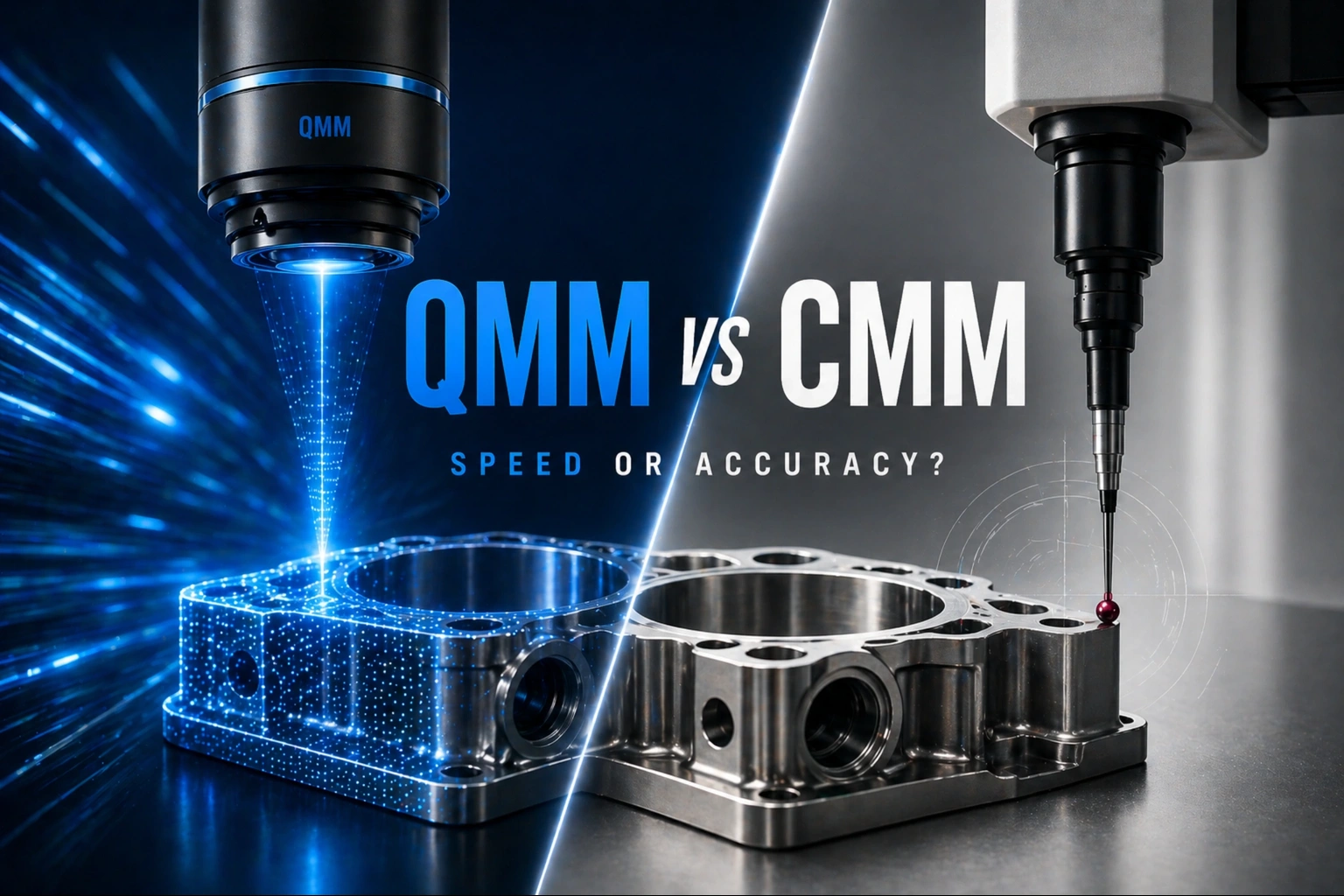
The traditional answer to "how do we inspect production parts?" was always a CMM. It's accurate, versatile, well-understood by quality auditors. The problem is that it's slow — 5–15 minutes per complex part on a typical bridge CMM, with compressed air requirements, climate-controlled rooms, and a minimum 2-year operator training curve.
For a plant running 500 parts per shift, that CMM is a production bottleneck — not a quality asset. The QMM (Quick Measuring Machine) was designed to solve exactly this problem. But it comes with trade-offs that matter.
How Each Instrument Works
Coordinate Measuring Machine (CMM)
A CMM uses a physical probe — tactile or scanning — that physically contacts the part surface to locate points. The XYZ position of each contact point is recorded with high precision. By taking enough points on a surface, the software computes the geometry, fits mathematical shapes, and calculates GD&T callouts. Accuracy of ±0.5–2 µm is achievable. The probe requires physical access to every surface being measured.
Quick Measuring Machine (QMM)
A QMM uses telecentric optics and a digital camera to capture part images from multiple angles. Software automatically identifies edges, measures feature dimensions, and calculates geometric relationships — without physical contact. Measurement cycle time is seconds, not minutes. A typical QMM measures 15–22 features in under 30 seconds. It cannot access internal bores, 3D surfaces, or features not visible from the measurement axis.
Head-to-Head Comparison
| Criterion | CMM (Bridge / Arm) | QMM (Optical) |
|---|---|---|
| Measurement Speed | 5–20 min per part | 8–30 sec per part |
| Throughput | 3–12 parts/hour | 120–450 parts/hour |
| Accuracy | ±0.5–2 µm | ±2–5 µm |
| 3D Surface Measurement | Yes — full 3D | No — 2D/2.5D only |
| GD&T Capability | Full 3D GD&T | Full 2D GD&T (position, angularity, profile) |
| Operator Skill Required | High — 1–2 year learning curve | Low — day 1 productive with CNC programs |
| Infrastructure | Climate control, compressed air, vibration isolation, dedicated room | Standard shop floor — no special room required |
| Part Setup Time | 10–30 min for complex fixturing | Under 60 seconds with pre-loaded programs |
| SPC / ERP Integration | Yes — via dedicated CMM software | Yes — native CSV/SPC export, real-time LAN feed |
| Investment Cost (India) | ₹20–60 lakh + room setup | ₹6–30 lakh (Opto H / V / VH, ex-works, GST extra) — no room setup |
| Contact with Part | Physical contact (probe) | Non-contact (suitable for soft/delicate parts) |
A CMM in a production environment is typically utilised at 20–40% of its potential throughput due to setup time, operator availability, and queue management. A QMM with pre-loaded CNC programs runs at near-continuous throughput. For plants measuring 100+ parts per shift on 2D features, the QMM typically provides 10–20x more inspection capacity for the same operating cost.
When QMM Wins Decisively
The QMM is the superior choice for production inspection when:
- Inspection volume is 50–1,000+ parts per shift
- Features are primarily 2D: OD, ID, length, shoulder angles, thread profile, edge geometry
- Multiple part numbers are inspected — QMM recipe switching adds under 10 seconds between SKUs
- SPC data feed to ERP is needed in real time
- Gauge R&R compliance for automotive or medical device customers is required (QMM achieves 4–9% typical)
- Non-contact inspection is needed for soft, coated, or delicate parts where CMM probe contact would mark or deform the surface
When CMM Remains the Better Choice
The CMM still wins when:
- Parts have complex 3D surfaces requiring full surface topology measurement
- Deep internal features or bores require probe access (QMM cannot access these optically)
- First article inspection (FAIR) or PPAP qualification requiring full 3D GD&T report is needed
- Tolerances are tighter than ±3 µm on critical features
- Parts are large (over 500 × 500 mm) and CMM travel is available
Production Inspection
- Turned parts: shaft OD, groove, thread
- Stamped/formed parts: flange, hole pattern
- Plastic parts: OD, wall thickness, ovality
- Fasteners and hardware
- Medical device ODs and edge geometry
- Continuous SPC during production runs
Qualification & Complex Parts
- First article inspection (FAIR)
- PPAP dimensional reports
- Complex machined housings (3D GD&T)
- Deep bore ID measurement
- Surface form and contour analysis
- Customer-witnessed qualification events
See the QMM's Speed Advantage First-Hand
Send us your part drawing. We'll demonstrate the Opto QMM measuring your features — in under 30 seconds.
The Smart Deployment Model: QMM + CMM Together
The highest-performing quality labs don't choose between QMM and CMM — they use both strategically. The CMM handles first article inspection, PPAP, and complex qualification work. The QMM handles continuous production sampling, SPC data collection, and 100% inspection where required.
A Pune automotive supplier documented this approach: CMM for PPAP and first article on all new tooling, Opto QMM-900 for 100% production inspection of all turned shafts. Result: CMM time freed for value-added work, QMM providing real-time SPC that detected a tooling drift event 3 hours before it would have become a reject batch.
What Most People Get Wrong About QMM Capability
The most common misconception: that QMM is a "compromise" — less accurate than a CMM, therefore second-choice. For 2D features in production environments, this is wrong. A CMM operating under shop-floor conditions (no climate control, operator variation, setup time pressure) often delivers ±5–8 µm real-world accuracy. A QMM in the same environment, with pre-loaded CNC programs and consistent fixturing, delivers ±3–5 µm — with 20x the throughput.
The QMM isn't less capable for its intended purpose. It's more capable — because it was designed for that purpose.
Practical Takeaway
If your production line generates more than 50 inspectable parts per shift and features are 2D, the maths on QMM vs CMM for production inspection is straightforward: the QMM inspects more parts, with lower operator cost, at equal or better real-world measurement uncertainty for those features.
Reserve your CMM for the work it does best — complex 3D qualification and first article. Deploy the QMM where volume demands it. The two instruments are complements, not competitors.
A QMM typically pays for itself in 8–18 months in a production environment — through savings in inspection labour (3–4 hours per operator per shift), elimination of CMM bottlenecks, reduction of re-inspection events, and earlier detection of process drift. The Pune automotive case study returned positive ROI in 11 months including instrument, installation, and training.