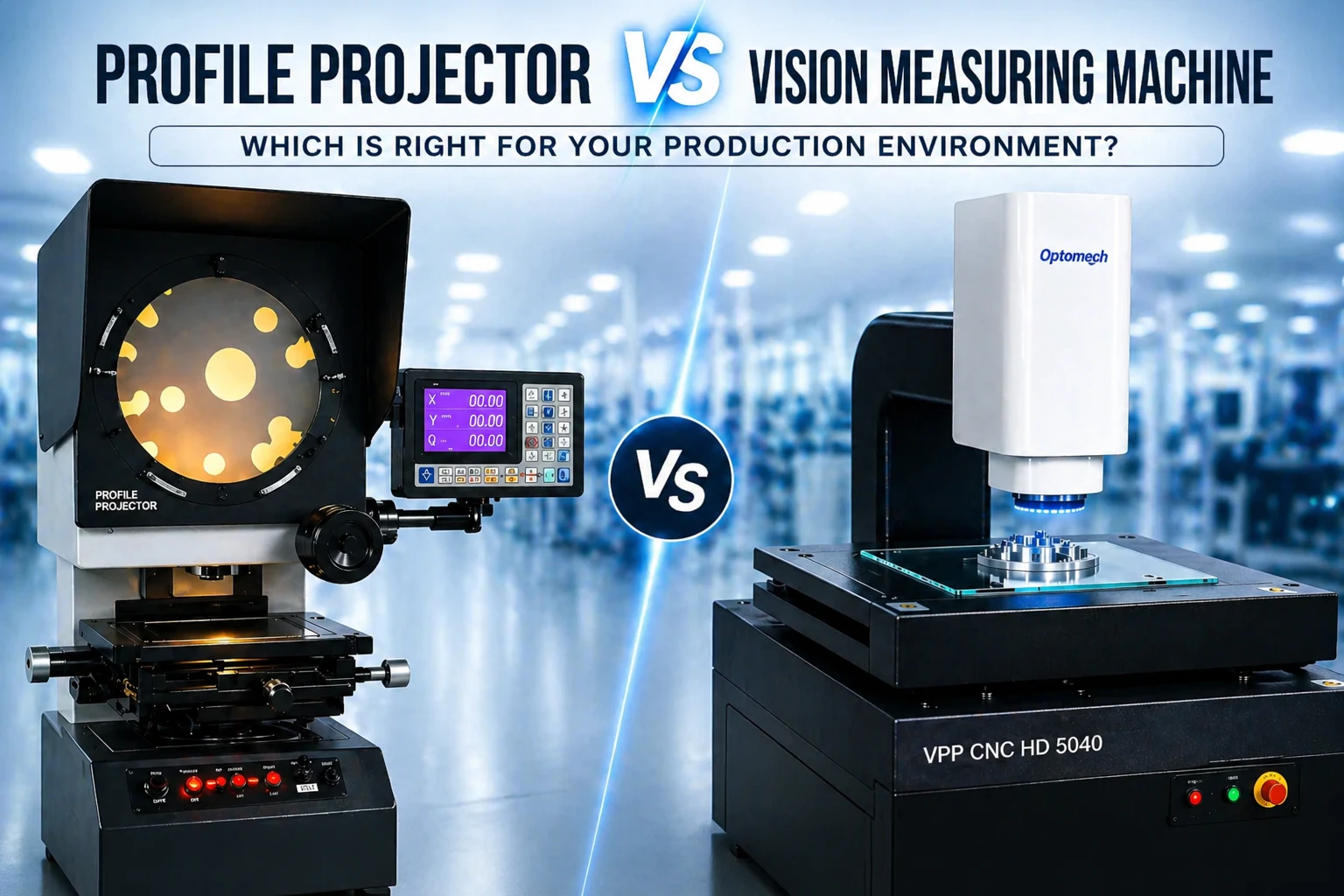
Two instruments dominate optical dimensional inspection in manufacturing: the profile projector and the vision measuring machine. Both project and measure — but they diverge sharply in speed, automation, data capability, and the complexity of parts they can handle. Choosing the wrong one costs you either money (over-specified) or quality (under-specified).
This guide explains what each instrument actually is, how they compare across the dimensions that matter, and how to decide which one your production environment actually needs.
Also comparing production-speed QMM? See the definitive Profile Projector vs VMM vs QMM — which to buy guide for a full decision framework and comparison table.
What is a Profile Projector?
A profile projector — also known as an optical comparator — projects a magnified silhouette (shadow) of a component onto a screen. The operator compares the shadow against overlay charts or takes measurements using a digital readout (DRO). It is a 2D optical measurement instrument, operated manually.
How it works
A collimated light source projects the part's shadow onto a magnified screen (typically 10× to 100×). The operator aligns the shadow to reference lines or measures features using the DRO stage controls.
- 2D silhouette measurement
- Manual operator-driven operation
- Cost-effective and simple to operate
- Suitable for simple, regular geometries
- No CNC automation (standard models)
- Thread profiles and pitch measurement
- Linear dimensions and radii
- Basic contour and edge inspection
- Cutting tools, gaskets, simple machined parts
How it works
A VMM uses a high-resolution digital camera, motorized XYZ stage, and measurement software to automatically locate, measure, and log features. CNC part programs run unattended and log results to SPC software.
- Non-contact measurement — no part deformation
- Semi-automatic or full CNC operation
- High repeatability, low gauge R&R
- Multi-parameter measurement in a single program
- Automatic data output for SPC/ERP
- Complex geometries with multiple features
- Plastic components and precision machined parts
- Batch inspection at production rates
- GD&T measurement and PPAP documentation
Most manufacturers start with a profile projector and outgrow it within 3–5 years as volumes rise or customer audit requirements escalate. Buying right the first time saves a second capital expenditure — and the VMM's time savings typically recover the price difference within 12–18 months.
Key Differences — Head-to-Head Comparison
| Feature | Profile Projector (Manual) | CNC VMM / VPP-CNC |
|---|---|---|
| Measurement Type | 2D silhouette only | 2D + advanced geometric analysis |
| Operation | Manual — operator dependent | Semi-auto / full CNC |
| Measurement Speed | 2–5 min per part | 8–30 sec per part (CNC program) |
| Accuracy | ±5–10 µm (alignment errors apply) | ±1–3 µm (motorized stage) |
| Operator Dependency | High — varies between operators | Low — repeatable CNC programs |
| GD&T Capability | Basic (diameter, length, angle) | Full (true position, perpendicularity, runout) |
| Gauge R&R Performance | 15–30% (marginal to poor) | 5–10% (capable) |
| Data Output | Limited — manual entry required | Detailed reports, CSV, SPC statistics |
| Multi-Feature Programs | Operator repositions per feature | Single CNC run measures all features |
| Initial Investment | ₹2–4 lakh (entry level) | ₹10–45 lakh (CNC VMM) |
| Best For | Simple profiles, low volume, spot checks | Complex parts, production inspection, audits |
The Middle Ground: CNC Video Profile Projector (VPP-CNC)
There is an instrument most buyers overlook — the CNC video profile projector. It combines a profile projector's optical path with a motorized stage, digital camera, and CNC part programs. You get VMM-level automation at roughly 40–50% of the cost.
Optomech's VPP-CNC 4030 achieves ±2 µm on the shop floor with CNC programs that run unattended. An aerospace Tier 2 supplier in Bengaluru eliminated CMM dependency for 2D inspection entirely after deploying the VPP-CNC 4030 — increasing inspection throughput from 18 to 72 parts per shift.
If your feature count is under 8 per part and all measurements are 2D, a VPP-CNC often delivers the best cost-to-capability ratio. Once you need surface measurements, 3D GD&T, or multi-axis rotation, step up to a full VMM.
Not Sure Which System Fits Your Parts?
Send us your component drawing. Our applications engineers will give you a direct recommendation — no sales call required.
When Should You Use a Profile Projector?
A profile projector is the right choice when:
- Parts are simple — 2D silhouette inspection is sufficient; no complex GD&T callouts
- Budget is constrained — entry-level instruments start from ₹2–4 lakh, with low operating cost
- Manual inspection is acceptable — operator skill is available and consistent; gauge R&R is not a formal customer requirement
- Inspection volume is low — fewer than 30 parts per shift, or inspection is spot-check rather than 100%
- Feature count is minimal — under 5–6 dimensions per part; operator repositioning is not a throughput bottleneck
When Should You Use a VMM?
A vision measuring machine is the right choice when:
- High accuracy is required — tolerances below ±5 µm where operator alignment error must be eliminated
- Components are complex — multiple features, mixed geometry types, or tight GD&T callouts beyond basic diameter and length
- Inspection needs to be fast — 50+ parts per shift where manual speed becomes a production bottleneck
- Data and reporting are critical — automotive PPAP, SPC control charts, ERP data integration, or gauge R&R requirements below 10%
- Reduced human dependency — consistent results across operators and shifts without retraining overhead
PP or VPP-CNC
- Inspection volume is low to medium
- Features are 2D silhouette-based
- Budget is constrained (₹2–18 lakh range)
- Parts are simple: tools, gaskets, profiles
- Formal SPC/PPAP not required
Vision Measuring Machine
- You inspect 100+ parts per shift
- GD&T callouts include true position or runout
- Automotive or aerospace audit requirements
- SPC data export to ERP/MES is needed
- Gauge R&R must be below 10%
The Industry Shift — Why VMMs Are Growing
Manufacturing quality standards are rising. Customers — particularly in automotive and aerospace — now routinely require PPAP submissions, SPC data, and formal gauge R&R studies. These requirements are difficult or impossible to satisfy with manual profile projectors.
As a result, VMMs and CNC video profile projectors are becoming the preferred choice for modern production inspection environments. The profile projector retains a strong role in tool rooms, development labs, and low-volume quality bays — but it is no longer the default choice for production inspection.
Conclusion
Both systems have their place in a well-equipped quality department. The right choice depends on four factors: complexity of parts, required accuracy, production volume, and need for automation and data.
For manufacturers aiming at consistent, repeatable, and scalable quality control — particularly those supplying to customers with formal audit and SPC requirements — vision-based systems provide a clear and measurable advantage. The investment pays back not in theory, but in reduced rework, lower gauge R&R, and eliminated inspection bottlenecks.
Imported VMM prices have risen significantly with GST and duty structures. Domestically manufactured instruments like the Opto VMM series offer comparable accuracy at 30–40% lower cost, with local service coverage — a meaningful factor when instrument downtime directly affects production schedules.