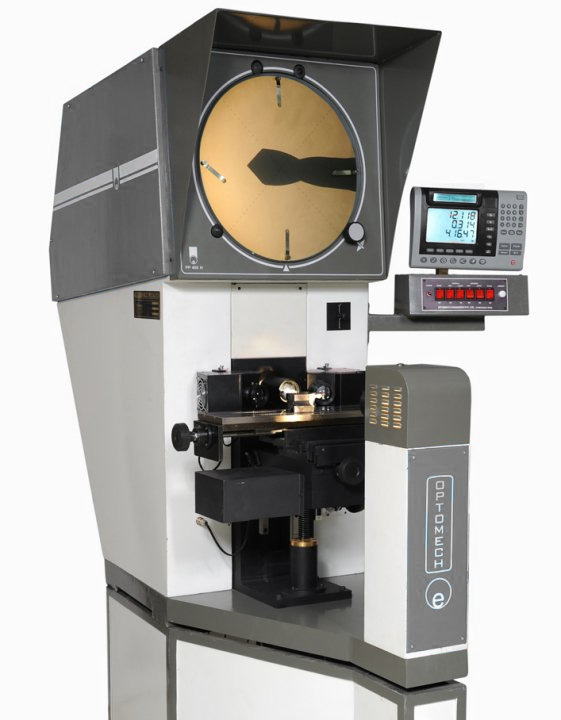
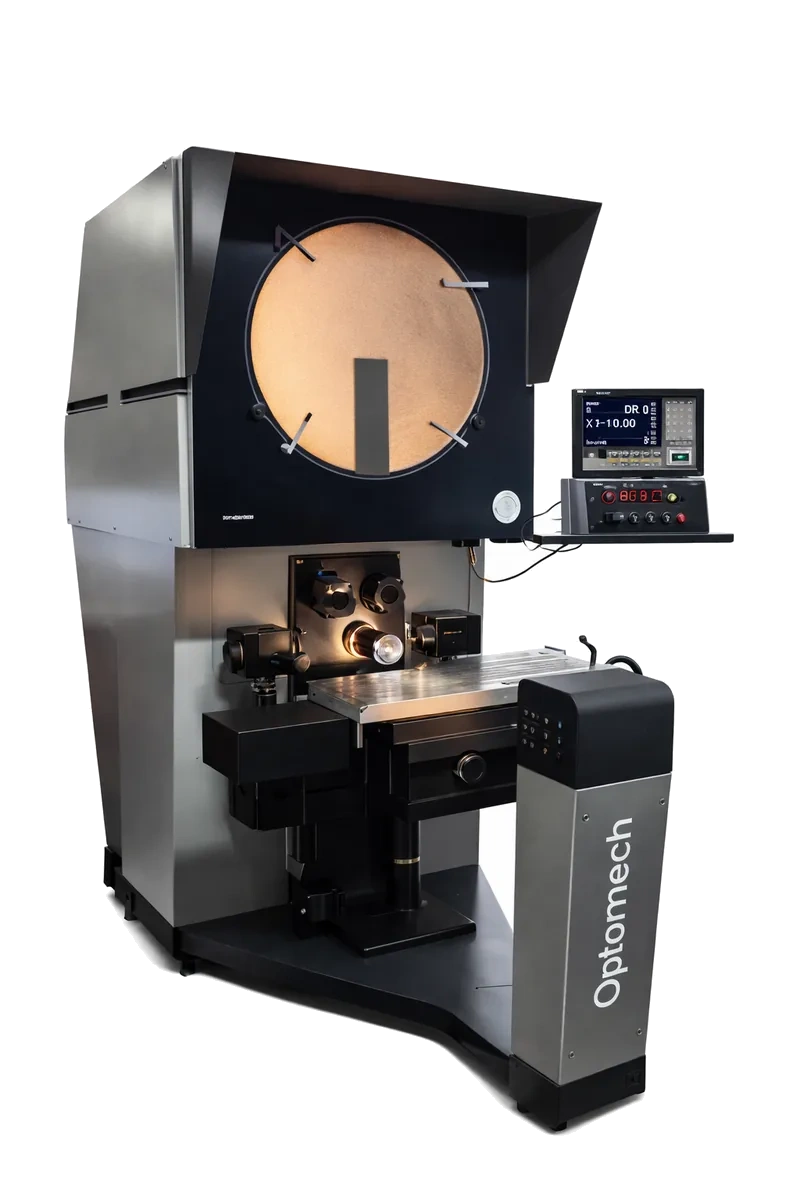
When your part has a length, a centre, or a helix — a horizontal profile projector is the right instrument. Motorised stage. Ball-screw drives. NABL-calibrated. Built in Hyderabad.
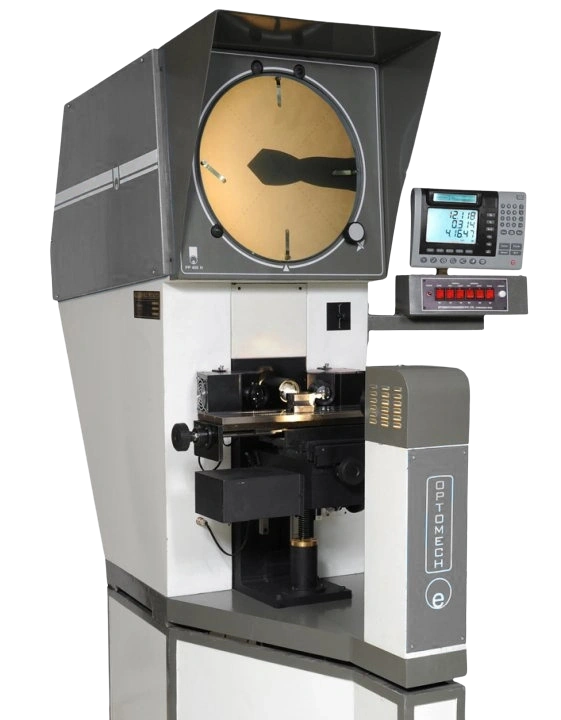
In a horizontal profile projector, the optical axis is horizontal and the part is positioned along that axis — supported between precision centres, in V-blocks, or on the motorised stage. The magnified profile is projected horizontally onto the vertical glass screen.
The key difference from vertical models: horizontal projectors are ideal for cylindrical, shaft-type, or elongated workpieces — parts that have a clearly defined axis of rotation or a length to be inspected.
The horizontal configuration allows the full cross-sectional profile of a shaft, lead screw, or threaded rod to be seen in a single view, with the thread axis perfectly aligned to the projection axis.
Optomech horizontal models (PP 400H and PP 600H) incorporate heavy-duty stages with motorised movement operating on ball screws and precision linear motion guides — enabling smooth, repeatable positioning across the large traverse.
Parts that rest flat on a stage — stampings, gears, inserts, PCBs, small machined components. The part must not exceed Ø210mm. Vertical models have XY stage traverses up to 250×150mm.
Parts with a defined axis: shafts, threaded rods, lead screws, worm gears, hobs. The horizontal configuration aligns the part axis with the optical axis for true cross-section view.
Contact Optomech — describe the part geometry and our application engineers will specify the correct model. We've solved this choice for 1,000+ customers over 45 years.
Unlike vertical models that use manual screwless XY stages, the PP 400H and PP 600H incorporate heavy-duty motorised stages driven by precision ball screws and linear motion guides. This enables smooth, controlled traversal across the full 250×150mm (PP 400H) or 300×600mm (PP 600H) measuring range — critical for tracking long features across shaft lengths.
The optical axis is perpendicular to the projection screen (horizontal). The part is positioned along this axis — its cross-section is what appears on the screen. For a threaded rod, the screen shows the full thread form in profile, including pitch, included angle, root radius, and crest flat simultaneously.
Precision centres (Small: 125mm centre height; Large: 200mm centre height) are used to mount shafts and cylindrical parts with their axis exactly aligned to the optical axis. This eliminates tilt error and enables accurate measurement of the full working length of the part.
Horizontal models use twin condenser surface illumination (rather than fibre-optic guides) for surface illumination, delivering brighter, more uniform surface lighting suited to long cylindrical workpieces. Profile illumination uses 24V/150W halogen lamps as on all Optomech models.
| Specification | PP 400H | PP 600H |
|---|---|---|
| Screen Size | Ø400mm | Ø600mm |
| Magnification (Std.) | 10× | 10× |
| Optional Lenses | 5×, 20×, 50×, 100× | 5×, 20×, 50×, 100× |
| Top Plate | 515×125mm | 650×230mm |
| Traverse X×Y | 250×150mm | 300×600mm |
| Working Area | 515×125mm | 650×230mm |
| Max Part Dia | Ø170mm | Ø210mm |
| Load Capacity | 25 kg | 25 kg |
| Contour Accuracy | ±0.05% | ±0.05% |
| Surface Accuracy | ±0.05% | ±0.05% |
| Linear Measurement | Encoder 1µm | Encoder 1µm |
| Angular Resolution | Encoder 1 sec | Encoder 1 sec |
| DRO Systems | OP-250/500/1000 | OP-250/500/1000 |
| Profile Illumination | 24V, 150W | 24V, 150W |
| Surface Illumination | Twin condenser 24V, 150W | Twin condenser 24V, 150W |
| Stage Movement | Motorised ball screw | Motorised ball screw |
| Net Weight | 175 kg | 250 kg |
| Dimensions (L×W×H) | 1450×550×3100mm | 1800×900×1900mm |
Threads on cylindrical parts (screws, lead screws, threaded rods, worm shafts) must be inspected in a cross-section view that shows the thread form — pitch, included angle, crest flat, root radius, and thread height simultaneously.
In a vertical projector, a threaded shaft would need to be tilted to present the thread axis to the optical axis — introducing error and requiring the tilting support accessory with careful setup.
In a horizontal projector, the shaft is mounted between centres with its axis aligned to the optical axis. The thread form is presented perfectly in the projection plane with no tilting error.
Thread parameters measurable on the Optomech PP 400H and PP 600H using overlay charts or DRO: pitch (mm or TPI), included angle, half-angle symmetry, crest flat width, root radius, thread height, flank angle deviation.
Thread standards covered: metric (ISO 68-1), unified (UNC/UNF/UNEF), Whitworth (BSW/BSF), ACME, trapezoidal, stub ACME, British Pipe (BSPP/BSPT), and NPT/NPTF.
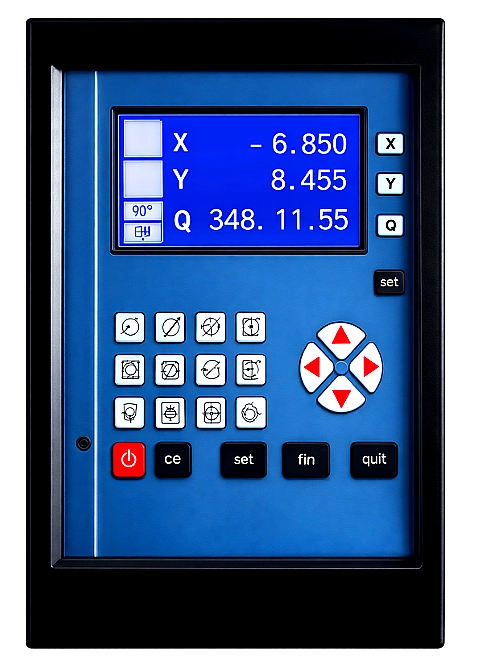
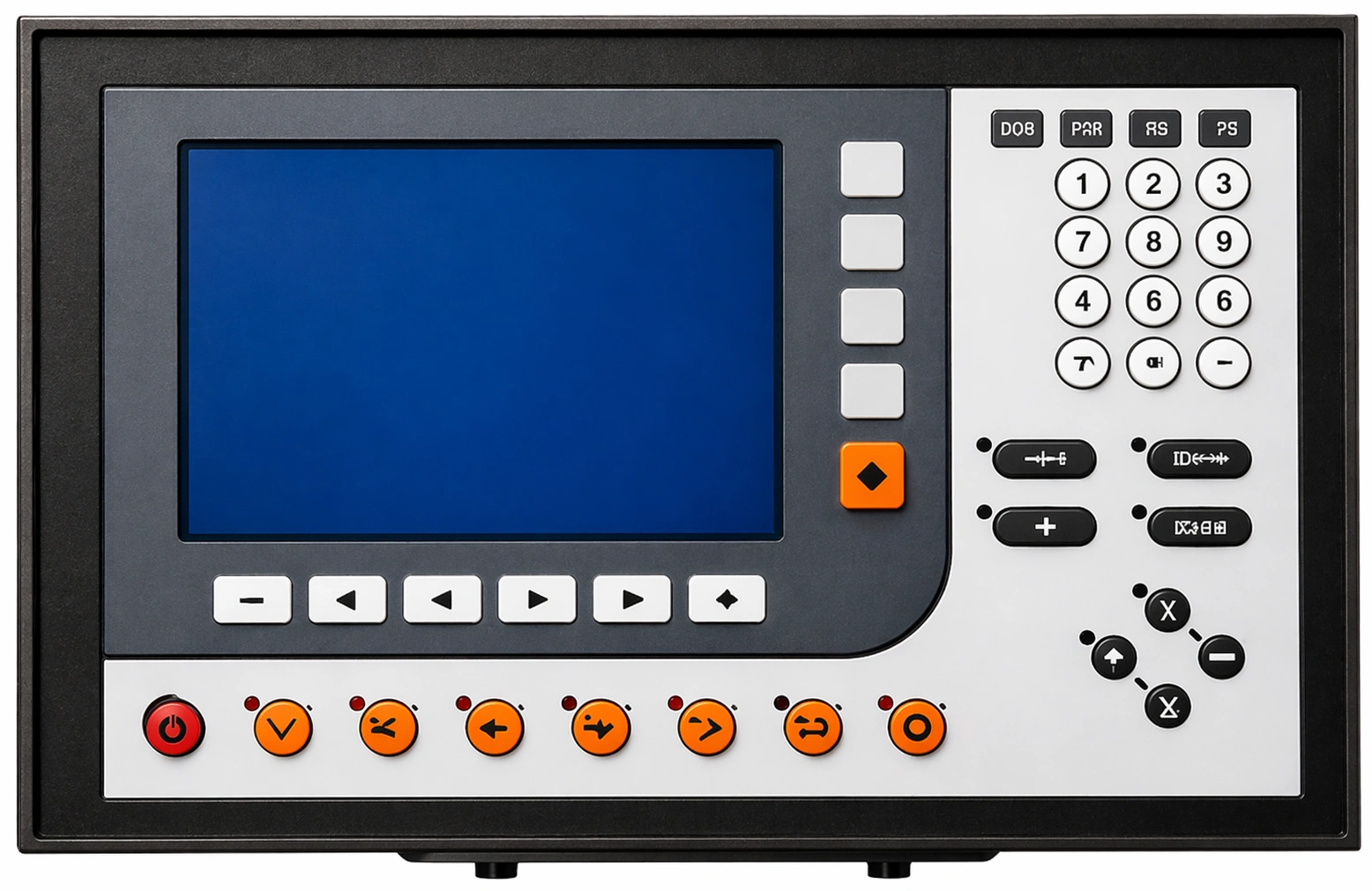
Every Optomech profile projector is paired with a Digital Readout system. Choose the tier that matches your inspection requirements — and upgrade later without replacing the optical instrument.
2-axis or 3-axis LCD readout — direct X and Y coordinate display from linear encoders
Zero-set, absolute / incremental switching, inch–metric toggle
Linear error correction for glass scale calibration
No computer required — self-contained measurement display
All OP-250 features, plus automatic edge detection — eliminates operator-dependent edge identification
Circle measurement, distance functions, angle calculation on-screen
Significantly improves measurement repeatability in repetitive inspection tasks
Optional RS-232 data output to PC or quality system
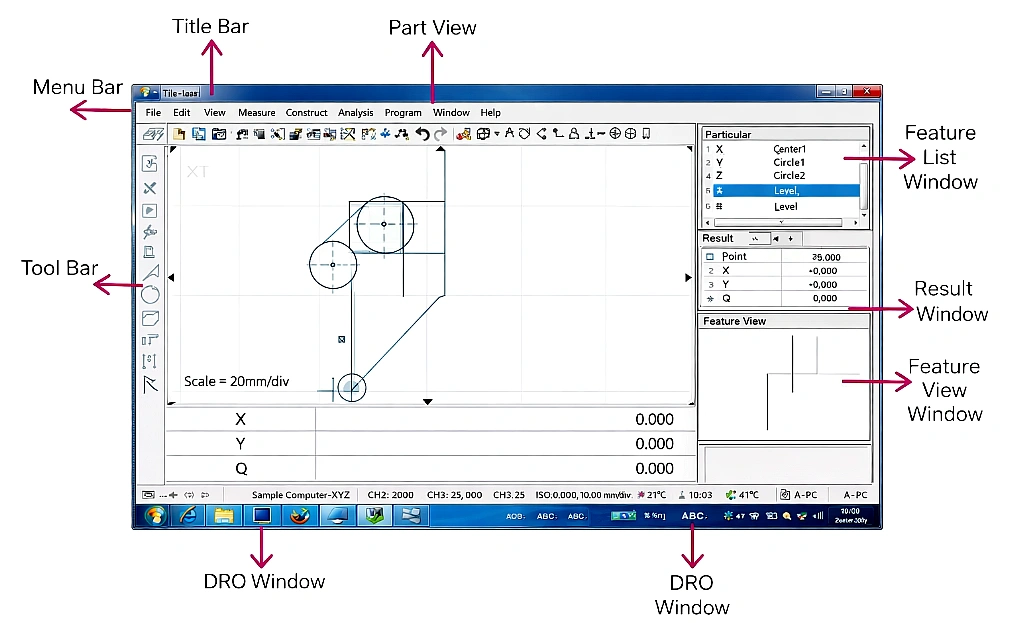
AutoCAD DXF import — overlay nominal profile onto live projected image
Full geometric measurement: points, lines, circles, arcs, angles, distances
Automated dimensional report with pass/fail, tolerances, GD&T
Reverse engineering: trace actual profile → export as DXF
SPC integration — real-time control charts and trend monitoring
Horizontal models use the same high-resolution telecentric projection lenses as vertical models — 10× standard, 5×, 20×, 50×, 100× optional. For horizontal projectors, telecentric optics are especially critical: the part extends along the optical axis, and any non-telecentric lens would show different magnification at different points along the shaft length. Telecentric projection ensures every cross-section is measured at exactly the same magnification, regardless of its position along the Z-axis.
Profile (Transmitted) Illumination: 24V / 150W halogen lamp projects a collimated beam through the workpiece, creating a sharp shadow silhouette on the screen. This is the primary mode for all contour measurement — threads, radii, gear teeth, complex forms.
Surface (Reflected) Illumination: Twin condenser lamps direct light directly onto the part surface from both sides. Reveals surface features, steps, holes, and markings that are not visible in silhouette. Standard on PP 400H and PP 600H horizontal models.
Tip: For complete inspection of a part that has both external contour features and surface markings or holes, use both illumination modes in sequence — profile light first for dimensional measurement, then switch to surface light to verify feature presence.
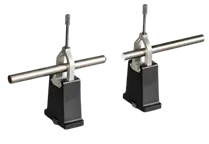
Precision hardened centres for mounting cylindrical and shaft-type parts along the optical axis. Small centres: 125mm centre height. Large centres: 200mm centre height. Essential for accurate shaft and lead screw inspection.
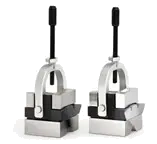
For supporting shafts and cylindrical parts without using centres. Available in 40×40mm and 20×20mm sizes.
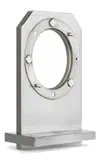
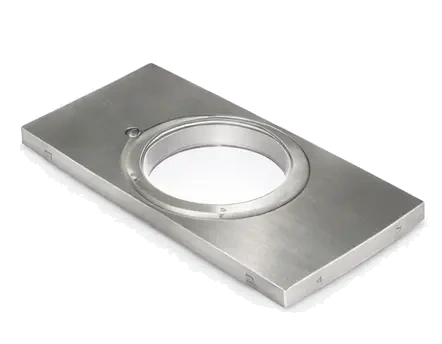
A flat glass plate (105mm Ø, 125mm centre height) for holding thin, flat parts vertically in the horizontal light path — enabling flat parts to also be inspected on the horizontal projector.
Standard thread profile charts (metric, unified, Whitworth, ACME, trapezoidal) and radius sets for direct visual comparison on the screen.
125mm glass window, 360° graduation, 5-minute vernier. For angular positioning of components relative to the optical axis.
Every PP 400H and PP 600H is supplied with NABL-traceable calibration certificate (Certificate No. C-0068). Accepted for ISO 9001, IATF 16949, and AS9100 QMS audits.
Thread form, pitch accuracy, and lead error measurement. Critical for machine tool and CNC axis manufacturers.
Worm gear tooth inspection, shaft shoulder profiles, spline geometry, and bearing seat measurement.
Precision aerospace bolt threads, stud profiles, and close-tolerance threaded fittings inspected to AS9100 requirements.
Cartridge cases (external thread), fuze components, projectile driving bands, and precision screw-thread gauges.
Hob profile inspection, broach tooth verification, tap thread form checking, and ground thread gauge calibration.
Any manufacturer of threaded components, cylindrical shafts, or elongated precision parts requiring accurate, non-contact profile measurement.
Every instrument leaves Hyderabad with a calibration certificate traceable to national standards. Your QMS audit is covered from day one — ISO 9001, IATF 16949, AS9100 compliant.
Manufactured at our 10,000 sq. ft Hyderabad facility — the home of profile projector manufacturer Hyderabad. Spares are stocked locally. Service response is hours, not weeks. No import lead times on critical components.
Since 1981, our engineers have installed Profile Projectors across automotive, aerospace, defence, and medical manufacturing. We understand your inspection challenge before you describe it.
Our parfocal telecentric lenses eliminate parallax error and Z-position sensitivity — the two most common sources of measurement uncertainty on inferior optical comparators.
Start with the OP-250 for direct inspection. Upgrade to OP-1000 metrology software when your SPC programme demands more. The optical instrument never changes — only the intelligence layer.
Vertical, horizontal, small screen, large screen — standardise on Optomech across all your profile projection needs. Common accessories, common service, single point of contact.
Request a demonstration at our Hyderabad facility, or speak with our engineers about which horizontal profile projector is right for your parts.
Service: Chinthaya · +91-9032364140 · info@optomech.in