Service: Chinthaya  ·  +91-9032364140  ·  info@optomech.in  ·  NABL Calibration Available
Vertical Profile Projectors

Vertical Optical Comparators
Built for Precision

Five models from 300 mm to 600 mm screen. Telecentric lenses, ±0.05% projection accuracy, 1 µm encoder resolution, and NABL-traceable calibration — for gears, inserts, stampings, and precision-machined components.

5Models
±0.05%Accuracy
1 µmResolution
600 mmMax Screen
NABLCalibrated

What is a Vertical Profile Projector?

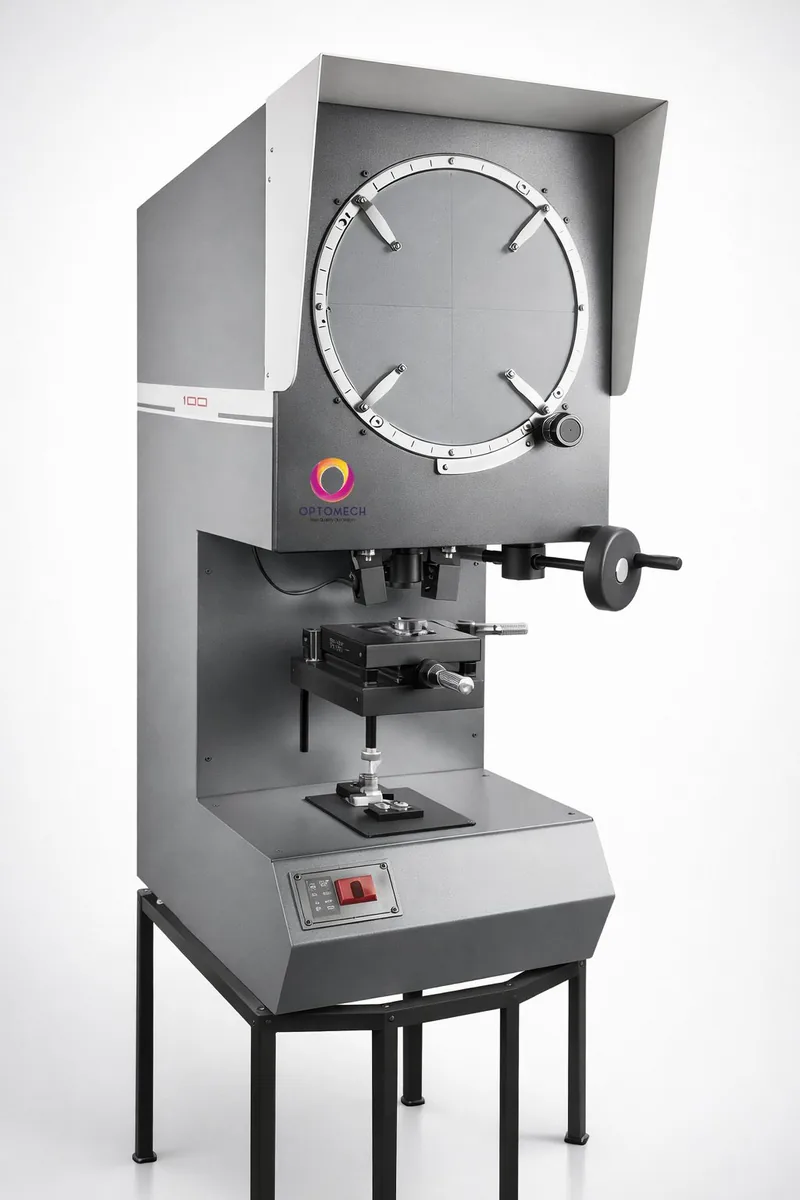
A vertical profile projector — also called a vertical optical comparator or shadowgraph — places the workpiece flat on a horizontal XY stage. A 24V/150W halogen lamp illuminates the part from below, and a telecentric projection lens creates a sharp, magnified shadow silhouette on the vertical screen above.

Because the part rests horizontally on the stage by gravity alone, vertical profile projectors suit compact, flat, and symmetrical components. No fixturing is required for most parts — place the component, focus, and measure.

Typical applications

  • Gear tooth profiles — involute form, pitch, and root radius
  • Cutting inserts and carbide tooling — edge geometry and relief angles
  • Stamped and blanked components — edge burr, hole diameter, and form
  • Injection-moulded parts — critical dimensions and wall thickness
  • Cams, templates, and gauges — contour verification against nominal
  • Springs and wire forms — coil diameter and pitch
  • Short fasteners and threaded components — external thread profile

How vertical projection works

1

Profile Illumination

A 24V/150W halogen lamp illuminates the workpiece from below, creating a crisp shadow silhouette free from surface reflections and lighting variation.

2

Telecentric Lens

The telecentric objective ensures chief rays remain parallel to the optical axis. Magnification is constant regardless of the part's Z-height, eliminating parallax error entirely.

3

Screen & Measurement

The projected image appears on a rotatable glass screen with reference cross-lines. Measurement is by overlay chart comparison, micrometer-head readout, or digital encoder DRO — depending on the model.

4

Surface Illumination

Twin fibre-optic conduits provide reflected surface illumination for inspecting holes, engraving, and surface features that do not appear in silhouette mode.

Vertical Profile Projector Range

From the compact entry-level PP 300TL to the large-format PP 600VE, every model uses telecentric optics and twin-source illumination. Choose by screen size, traverse range, and measurement system requirement.

PP 300TL
Ø300 mm Screen  ·  Entry Level  ·  Micrometer Measurement
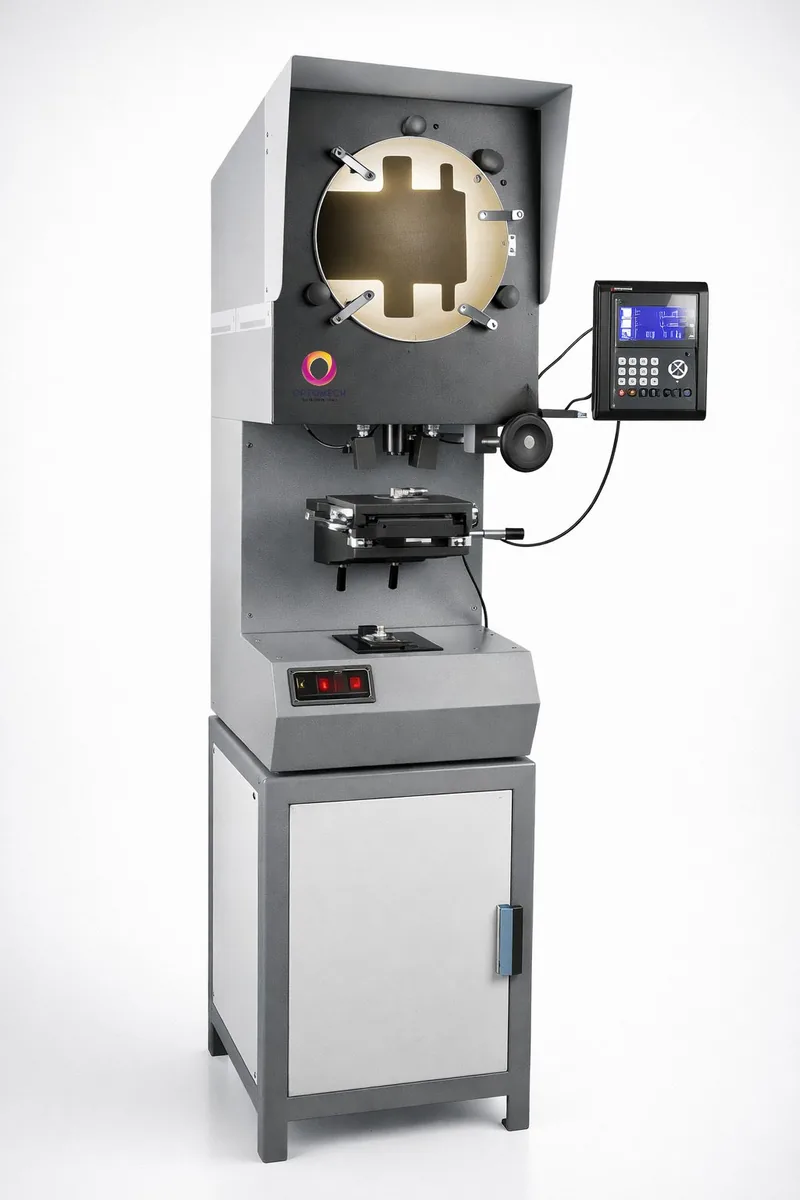
PP 300TL vertical profile projector 300mm screen
Screen Diameter
Ø 300 mm
Traverse (X × Y)
25×25 or 50×50 mm
Top Plate
145 × 145 mm
Max Part Diameter
Ø 60 mm
Load Capacity
5 kg
Contour Accuracy
± 0.1%
Surface Accuracy
± 0.15%
Linear Measurement
Micrometer LC 10 µm
Angular
Rotary Screen LC 2 min
DRO Support
Not applicable
Net Weight
65 kg
Dimensions (L×W×H)
655 × 420 × 1040 mm
Best for: Go/no-go inspection using overlay charts, incoming quality checks, and tool room verification of small components where digital readout is not required. Standard magnification is 10×; optional 20× and 50× lenses are available.
PP 300TLE
Ø300 mm Screen  ·  DRO-Ready  ·  1 µm Linear Encoder
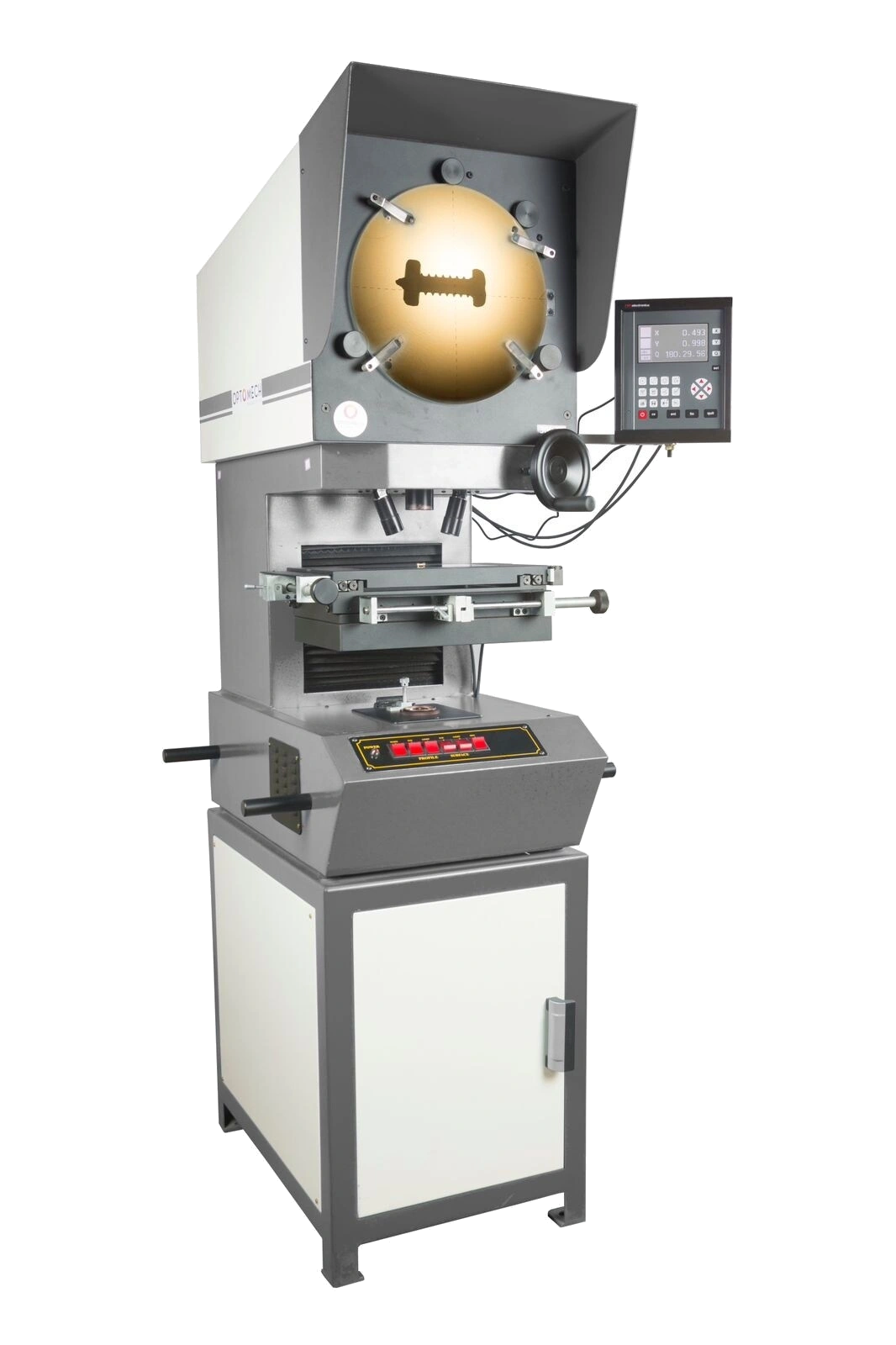
PP 300TLE vertical profile projector with digital readout
Screen Diameter
Ø 300 mm
Traverse (X × Y)
100 × 100 mm
Top Plate
230 × 230 mm
Max Part Diameter
Ø 60 mm
Load Capacity
10 kg
Contour Accuracy
± 0.05%
Surface Accuracy
± 0.05%
Linear Encoder
1 µm resolution
Rotary Encoder
LC 1 arc-second
DRO Options
OP-250 / OP-500 / OP-1000
Net Weight
65 kg
Dimensions (L×W×H)
655 × 420 × 1040 mm
Best for: Compact labs and quality stations needing encoder-based digital measurement on a 300 mm screen. Doubles the traverse of the TL (100×100 mm), improves accuracy to ±0.05%, and supports all three DRO options. Magnification options: 5×, 10×, 20×, 50×, and 100×.
PP 300TE
Ø300 mm Screen  ·  Large Stage  ·  200×100 mm Traverse
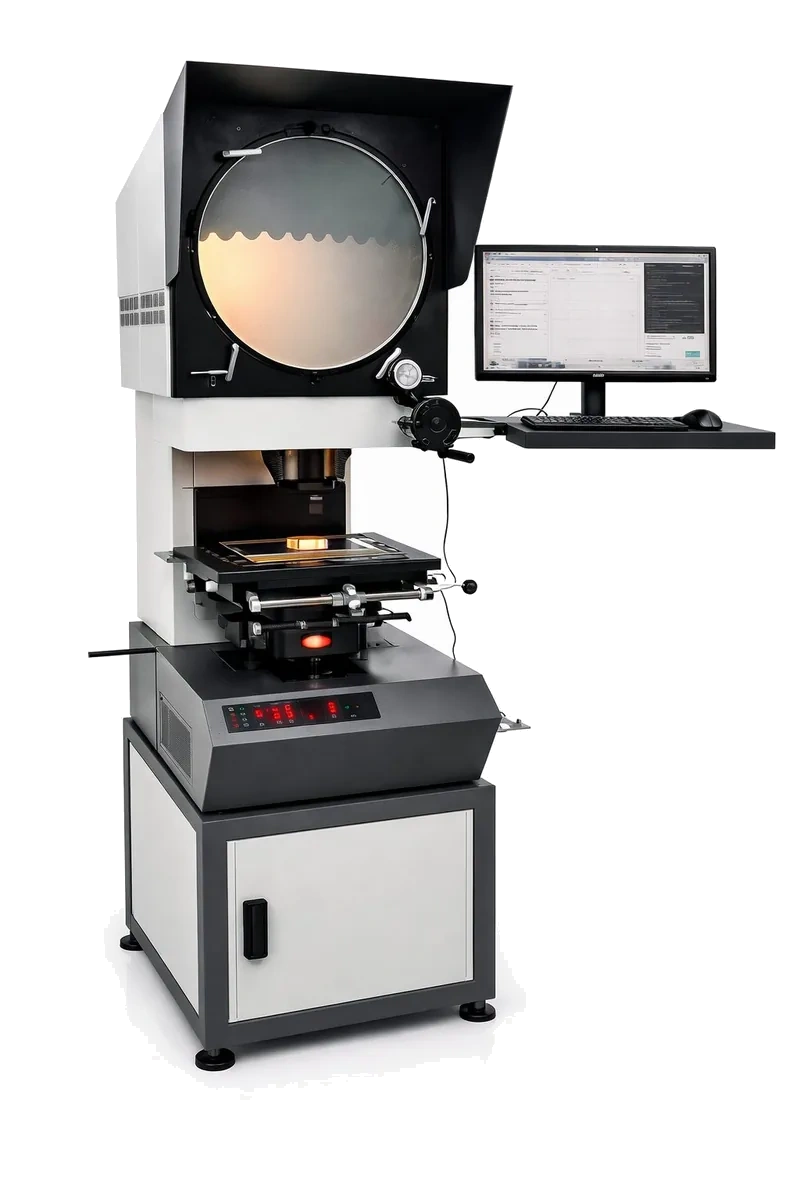
PP 300TE optical profile projector 200x100mm traverse
Screen Diameter
Ø 300 mm
Traverse (X × Y)
200 × 100 mm
Top Plate
350 × 210 mm
Max Part Diameter
Ø 130 mm
Load Capacity
25 kg
Contour Accuracy
± 0.05%
Surface Accuracy
± 0.05%
Linear Encoder
1 µm resolution
Rotary Encoder
LC 1 arc-second
DRO Options
OP-250 / OP-500 / OP-1000
Net Weight
90 kg
Dimensions (L×W×H)
800 × 450 × 1100 mm
Best for: Production floors inspecting medium-sized components up to Ø130 mm and 25 kg on a 300 mm screen. The large 350×210 mm top plate and 200×100 mm traverse handle components too large for the TLE stage. All DRO options and magnification lenses (5×–100×) are compatible.
PP 400TE
Ø400 mm Screen  ·  Mid-Range  ·  Parts to Ø170 mm
PP 400TE vertical profile projector 400mm screen
Screen Diameter
Ø 400 mm
Traverse (X × Y)
250 × 150 mm
Top Plate
380 × 280 mm
Max Part Diameter
Ø 170 mm
Load Capacity
25 kg
Contour Accuracy
± 0.05%
Surface Accuracy
± 0.05%
Linear Encoder
1 µm resolution
Rotary Encoder
LC 1 arc-second
DRO Options
OP-250 / OP-500 / OP-1000
Net Weight
120 kg
Dimensions (L×W×H)
870 × 550 × 1270 mm
Best for: Automotive and aerospace component inspection where a larger screen improves visibility of complex profiles. The 400 mm screen and 380×280 mm top plate suit medium-to-large stamped parts, cam profiles, template gauges, and components up to Ø170 mm.
PP 600VE
Ø600 mm Screen  ·  Largest Vertical  ·  Parts to Ø210 mm
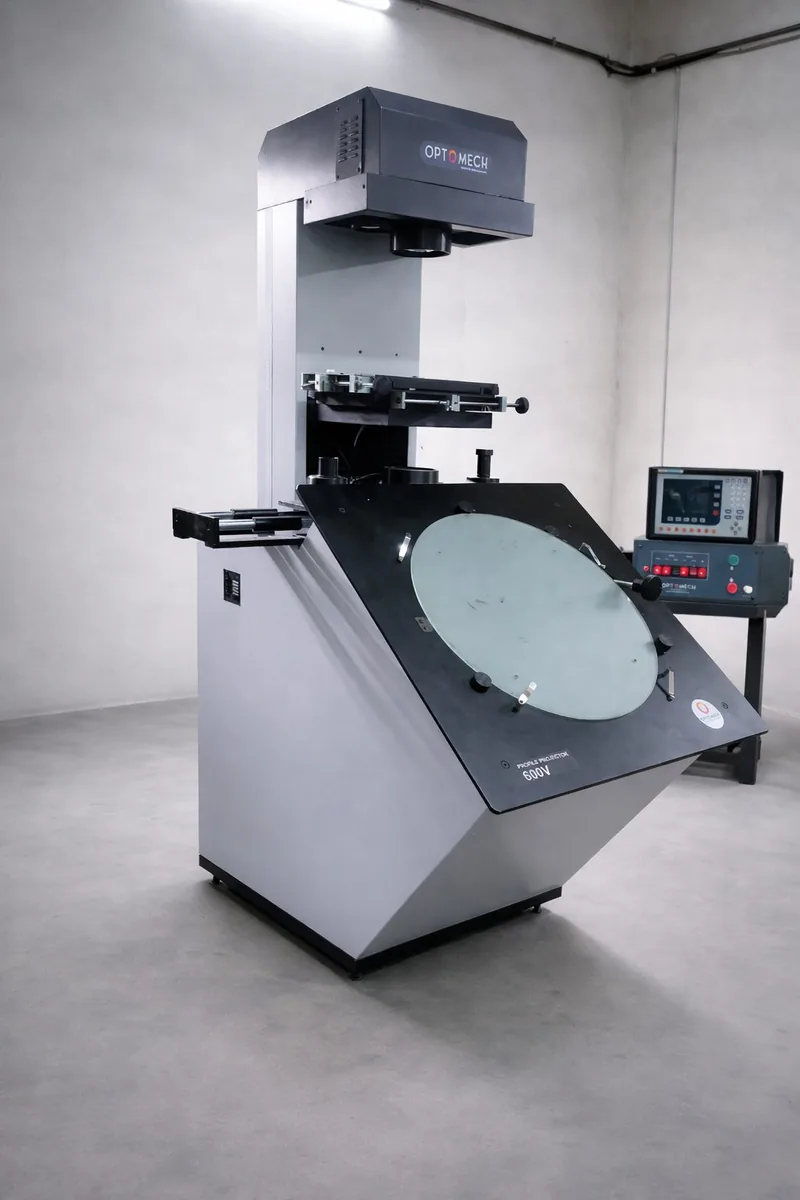
PP 600VE large screen vertical profile projector 600mm
Screen Diameter
Ø 600 mm
Traverse (X × Y)
250 × 150 mm
Top Plate
350 × 210 mm
Max Part Diameter
Ø 210 mm
Load Capacity
25 kg
Contour Accuracy
± 0.05%
Surface Accuracy
± 0.05%
Linear Encoder
1 µm resolution
Rotary Encoder
LC 1 arc-second
DRO Options
OP-250 / OP-500 / OP-1000
Net Weight
160 kg
Dimensions (L×W×H)
1270 × 850 × 1950 mm
Best for: Quality laboratories where every fine detail of a complex profile must be clearly visible. The 600 mm screen — twice the area of the 400 mm model — makes fine features unmistakable even at lower magnifications. Ideal for large gear profiles, complex cams, large stamped blanks, and aero-structural components up to Ø210 mm.
Quick Compare

All 5 Models at a Glance

Use this table to select the right vertical profile projector for your application. All models include profile illumination, surface illumination, telecentric optics, and NABL calibration.

Specification PP 300TL PP 300TLE PP 300TE PP 400TE PP 600VE
Screen DiameterØ 300 mmØ 300 mmØ 300 mmØ 400 mmØ 600 mm
Traverse (X × Y)50 × 50 mm100 × 100 mm200 × 100 mm250 × 150 mm250 × 150 mm
Max Part DiameterØ 60 mmØ 60 mmØ 130 mmØ 170 mmØ 210 mm
Load Capacity5 kg10 kg25 kg25 kg25 kg
Contour Accuracy± 0.1%± 0.05%± 0.05%± 0.05%± 0.05%
Linear MeasurementMicrometer 10 µmEncoder 1 µmEncoder 1 µmEncoder 1 µmEncoder 1 µm
Angular MeasurementScreen LC 2 minEncoder 1 secEncoder 1 secEncoder 1 secEncoder 1 sec
DRO Compatible
Magnifications10×, 20×, 50×5× – 100×5× – 100×5× – 100×5× – 100×
Net Weight65 kg65 kg90 kg120 kg160 kg
Footprint (L × W)655 × 420 mm655 × 420 mm800 × 450 mm870 × 550 mm1270 × 850 mm

Choose Your DRO — OP-250, OP-500, or OP-1000

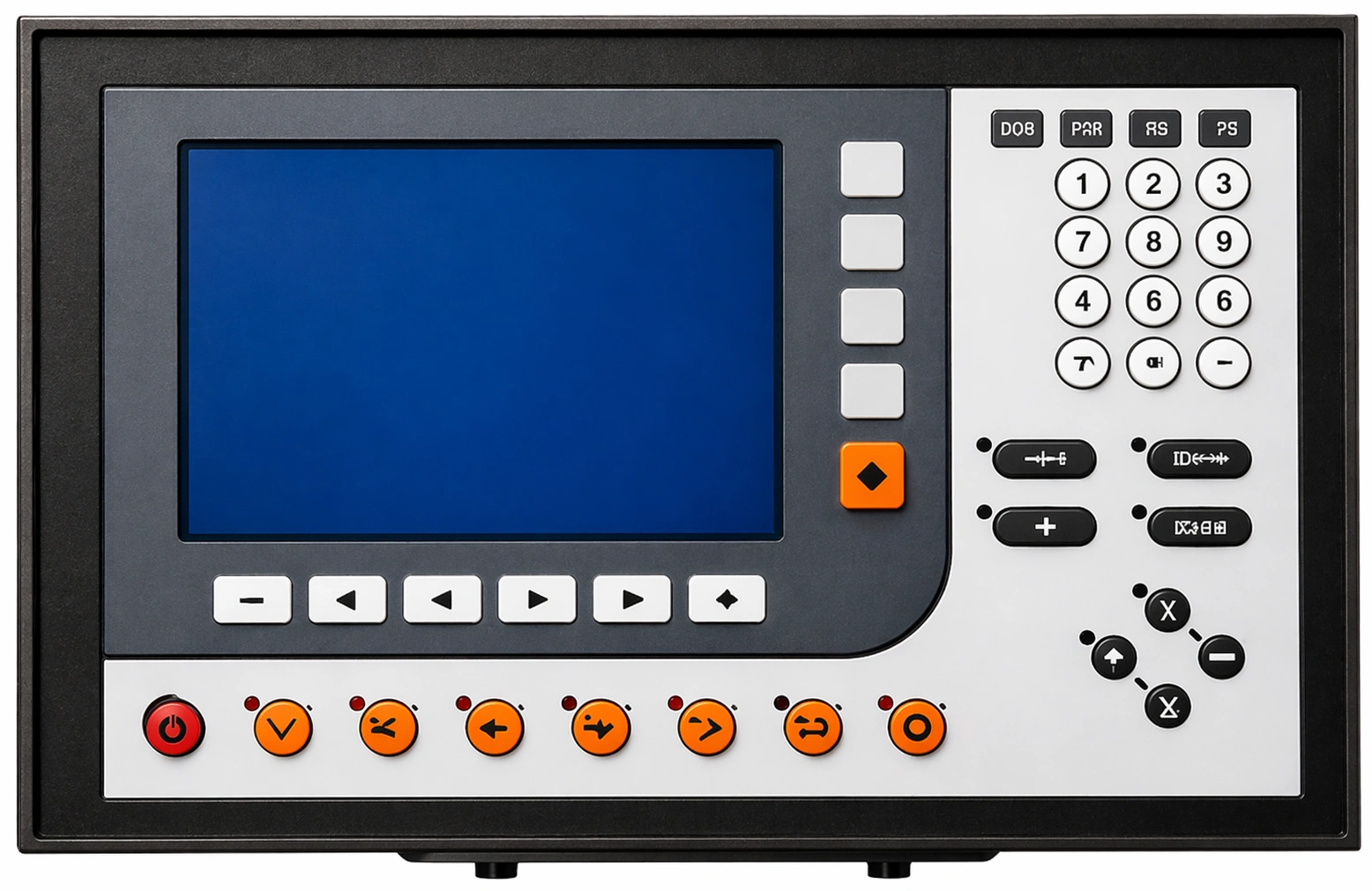
All encoder-equipped models (PP 300TLE through PP 600VE) are compatible with three DRO systems. The DRO connects via the encoder interface and can be upgraded at any time without modifying the optical body.

Standard
OP-250
Simple 3-Axis System

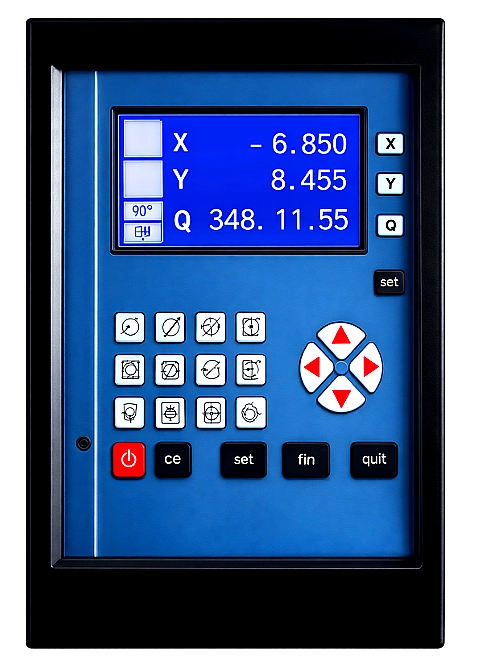
X, Y, and angular (θ) digital display with 1 µm and 1 arc-second resolution

Absolute and incremental measurement modes

Zero-set, datum shift, and preset functions

No PC required — fully self-contained panel-mount unit

Best forDirect coordinate readout and go/no-go decisions on the shop floor.
Computerised
OP-1000
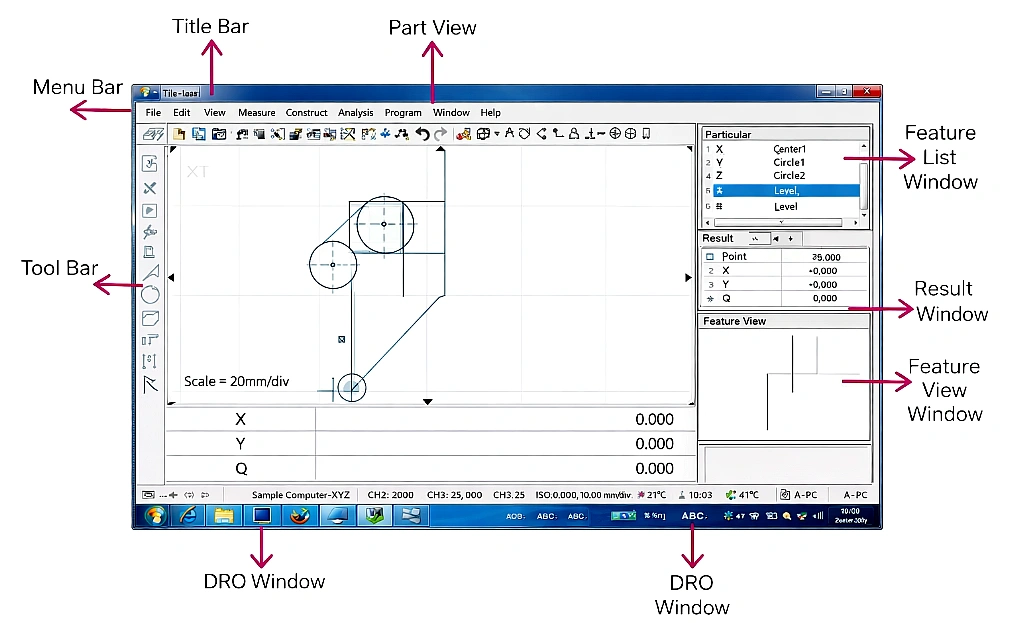
Metrology Software System

All OP-500 functions plus PC-based metrology software

DXF/CAD import for nominal overlay and deviation reporting

SPC reporting, measurement archives, and trend analysis

Reverse engineering capability — output measured profiles as DXF

Best forR&D labs, PPAP documentation, IATF 16949 SPC, and reverse engineering.
Optics

Telecentric Optics & Dual Illumination

Every Optomech vertical profile projector uses telecentric projection lenses as standard — the same optical principle used in coordinate measuring machines.

🔭

Telecentric Projection Lens

In a telecentric lens, chief rays travel parallel to the optical axis throughout image space. This means magnification is constant — a part edge at 10 mm above the stage produces the same projected dimension as the same edge at 12 mm above the stage.

All Optomech vertical profile projectors include a 10× telecentric lens as standard. Optional lenses from 5× to 100× are available and interchangeable across the range (PP 300TLE through PP 600VE).

10× std. 20× 50× 100×
💡

Dual Illumination System

Profile illumination uses a 24V/150W halogen lamp below the stage. Light passes through the workpiece and is captured by the objective lens, producing a sharp, high-contrast silhouette for all contour measurements — edges, diameters, angles, radii, and thread profiles.

Surface illumination uses twin fibre-optic conduits to flood the upper surface with controlled light. This reveals engraved text, countersinks, surface defects, hole positions, and through-features that are invisible in profile mode.

Both illumination systems are standard on all five vertical models.

Accessories & Optional Equipment

Extend the capability of your vertical profile projector with purpose-built accessories, designed and manufactured by Optomech for direct compatibility.

Rotary table for profile projector

Rotary Table

Precision rotary table for the work stage — enables angular indexing for circular pitch, gear tooth spacing, and rotational symmetry measurement without repositioning the part.

Tilting support for profile projector

Tilting Support

Tilts the workpiece at a controlled angle relative to the projection axis — essential for measuring helix angles on taps, reamers, and drills.

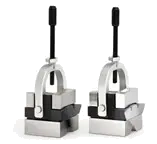
V-blocks with clamps for profile projector

V-Blocks with Clamps

Precision V-blocks with clamps for securing cylindrical workpieces on the stage. Ensures repeatable seating — particularly useful for short shafts and pins.

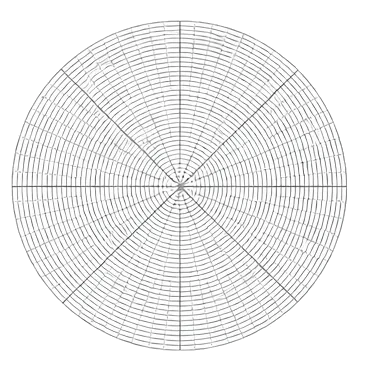
Overlay charts for optical comparator

Overlay Charts

Precision-printed transparent charts for direct comparison — thread forms (metric, unified, Whitworth), gear tooth profiles, radius standards, and custom profiles.

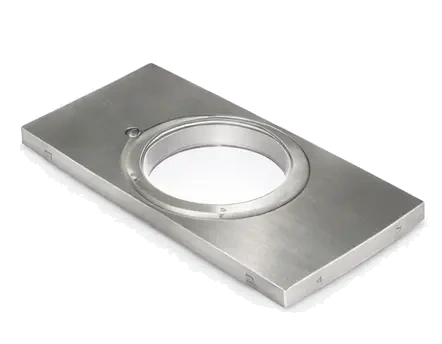
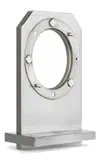
Vertical glass support plate

Vertical Glass Support Plate

Optical-quality glass plate for supporting thin, flexible, or delicate parts that cannot be placed directly on the metal stage without distortion.

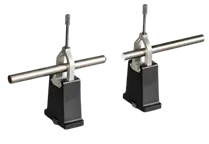
Centres for profile projector

Large & Small Centres

Precision centres for supporting short shafts and turned components between centres on the stage — accurate measurement of external contours and concentricity.

Why Choose Optomech Profile Projectors?

🏭

Manufactured in India Since 1981

Over four decades of optical instrument manufacturing from Hyderabad. Every profile projector is built, assembled, and calibrated in-house — full control over every component.

📜

NABL-Traceable Calibration

Each instrument ships with a NABL-accredited calibration certificate (No. C-0068), traceable to national standards. Accepted under ISO 9001, IATF 16949, and AS9100 audits.

🔬

True Telecentric Optics

All models use genuine telecentric lenses. Constant magnification regardless of Z-position eliminates the single biggest source of parallax error in optical comparator measurement.

⬆️

Upgradeable DRO Path

The DRO interface is standardised across PP 300TLE through PP 600VE. A machine purchased with OP-250 can be upgraded to OP-500 or OP-1000 at any time — protecting your investment.

🛠️

5 Models, One Ecosystem

Accessories, lenses, and DRO systems are interchangeable across the vertical range. A rotary table bought for a PP 300TE is directly compatible with a PP 600VE.

📞

After-Sales Support

Dedicated service team with field presence across India. Annual maintenance contracts, lamp and encoder replacement, DRO calibration, and on-site training available.

FAQ

Frequently Asked Questions

What is a vertical profile projector?+
A vertical profile projector places the workpiece on a horizontal XY stage. Light passes through from below, and a telecentric lens projects a magnified shadow silhouette onto a vertical screen. Measurements are taken by comparing the shadow against overlay charts or by reading XY coordinates via micrometer heads or digital encoders. Vertical models suit flat and compact parts — gears, inserts, stampings, and small machined components.
What is the difference between PP 300TL and PP 300TLE?+
The PP 300TL uses micrometer heads (10 µm resolution) and a manually-rotated screen (LC 2 minutes) with no DRO support. The PP 300TLE adds 1 µm linear encoders, a 1 arc-second rotary encoder, doubles the traverse (100×100 mm vs 50×50 mm), improves accuracy to ±0.05%, and is fully compatible with all three DRO options (OP-250, OP-500, OP-1000).
Which vertical profile projector model should I choose?+
Choose PP 300TL for simple overlay chart inspection with no DRO requirement. Choose PP 300TLE for encoder-based digital measurement on a compact footprint. Choose PP 300TE for parts up to Ø130 mm and 25 kg. Choose PP 400TE for a larger 400 mm screen with parts up to Ø170 mm. Choose PP 600VE for the largest screen and parts up to Ø210 mm where maximum visibility is essential.
What does telecentric lens mean and why does it matter?+
A telecentric lens maintains parallel chief rays along the optical axis, keeping magnification constant regardless of the part's Z-height above the stage. This eliminates parallax error — a major source of measurement uncertainty. Without telecentric optics, even a 1 mm change in part height can introduce 0.5–2% magnification error, making accurate measurement impossible without precise Z-positioning.
What DRO options are available?+
Three DRO systems are available for all encoder-equipped models: OP-250 is a simple 3-axis digital readout. OP-500 adds automatic optical edge detection and geometric calculation functions. OP-1000 is a full computerised metrology system with DXF import, SPC reporting, and reverse engineering capability. All three connect via the encoder interface and can be upgraded at any time.
What projection accuracy do these machines achieve?+
PP 300TLE, PP 300TE, PP 400TE, and PP 600VE achieve ±0.05% projection accuracy (contour and surface), certified by NABL-traceable calibration. The PP 300TL achieves ±0.1% contour and ±0.15% surface. For a 100 mm screen dimension, ±0.05% means the error is within ±0.05 mm. Linear encoder resolution is 1 µm; rotary encoder is 1 arc-second on encoder-equipped models.
Can I use a vertical profile projector for thread inspection?+
Yes, with limitations. Vertical models can inspect external thread profiles on short threaded components placed on the stage — measuring pitch, angle, and root radius using overlay charts or DRO. For long threaded rods, lead screws, and worm gears that must be supported along their axis, the horizontal PP 400H or PP 600H is better suited as it provides a true cross-section view.
Do these machines come with calibration certificates?+
Yes. Every Optomech profile projector ships with a NABL-accredited calibration certificate (No. C-0068), traceable to national measurement standards. Accepted for QMS audits under ISO 9001, IATF 16949, and AS9100. Recalibration services are available at scheduled intervals.
Ready to See It in Your Lab?

Request a demonstration, get a quotation, or ask our application engineers which model fits your requirement.

Request a Demo Get a Quote

Call: +91-9032364140  ·  Email: info@optomech.in

Explore More

Related Products