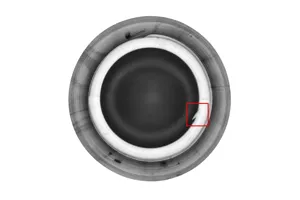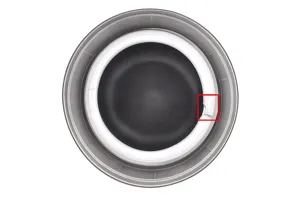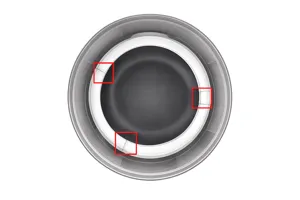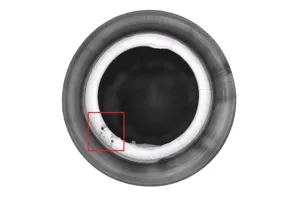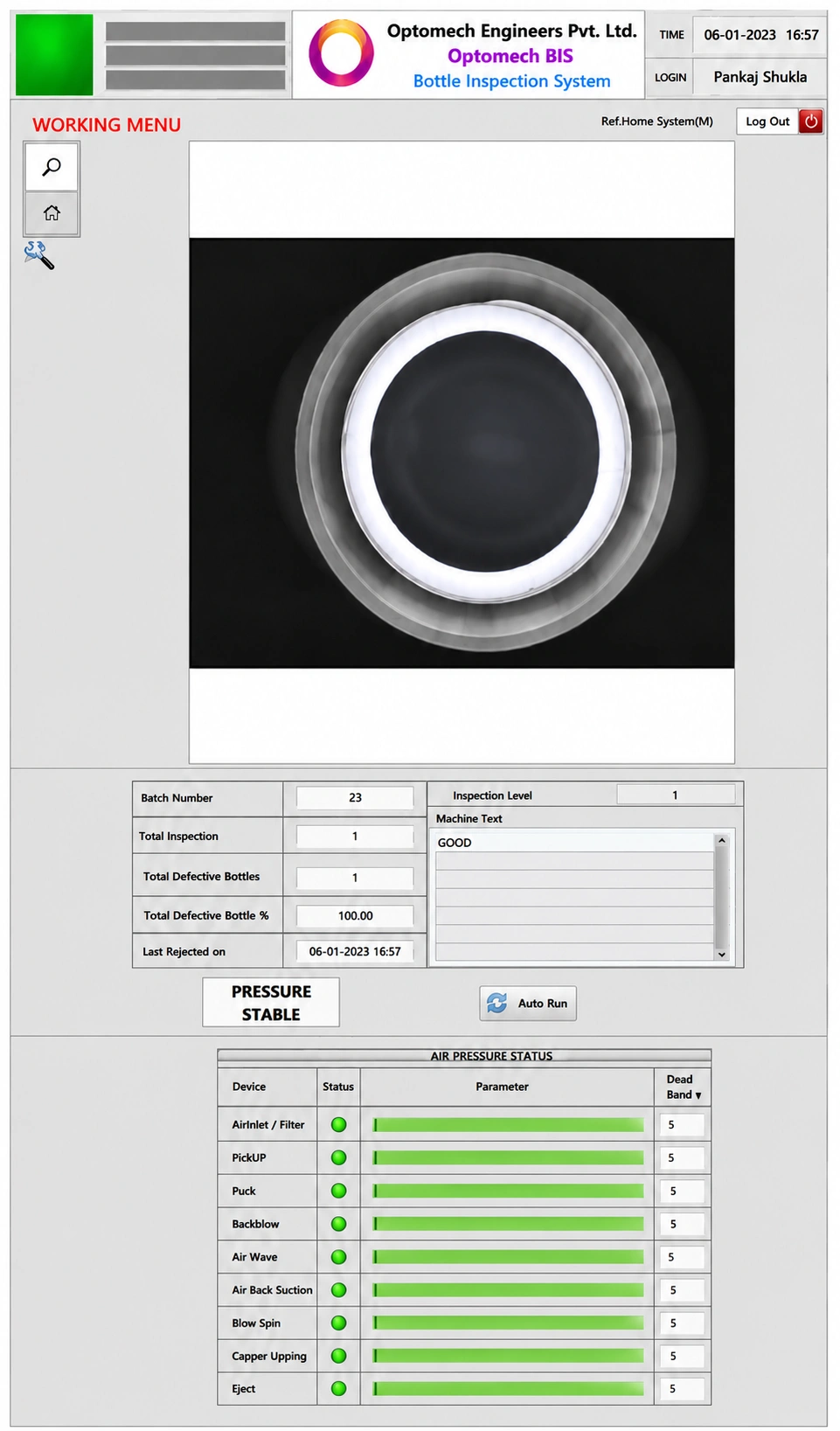
The sealing surface is the most critical millimetre of every bottle. A single flash, cut, or trace of product contamination on the lip breaks the hermetic seal — causing leaks, customer returns, and regulatory risk. The Optomech BIS-SC inspects 100% of bottles at up to 7,000 per hour, catching every defect before the cap goes on.
The top sealing surface (bottle lip) is just a few millimetres wide — yet it is the sole contact point between the bottle and its cap or induction seal. Flash, short moulding, cuts, material inclusions, or even traces of the filled product on this surface will prevent a hermetic seal, leading to leakage, contamination, and spoilage.
Flash, short mould, cuts and material inclusions from the moulding process create micro-gaps on the sealing surface that no visual manual check can reliably catch at production speed.
During filling, even a correctly moulded bottle can have product, powder, or liquid deposited on its lip — contaminating the sealing surface before the cap is applied. This is invisible in a standard visual check but causes leaks in transit.
Pharmaceutical, food, nutraceutical, and agrochemical products require hermetically sealed containers to meet regulatory requirements, maintain product integrity, and protect consumer safety.
At modern line speeds of 5,000–7,000 bottles per hour, manual inspection of each sealing surface is impossible. Inspectors fatigue within minutes and miss the very defects that cause the most costly customer complaints.
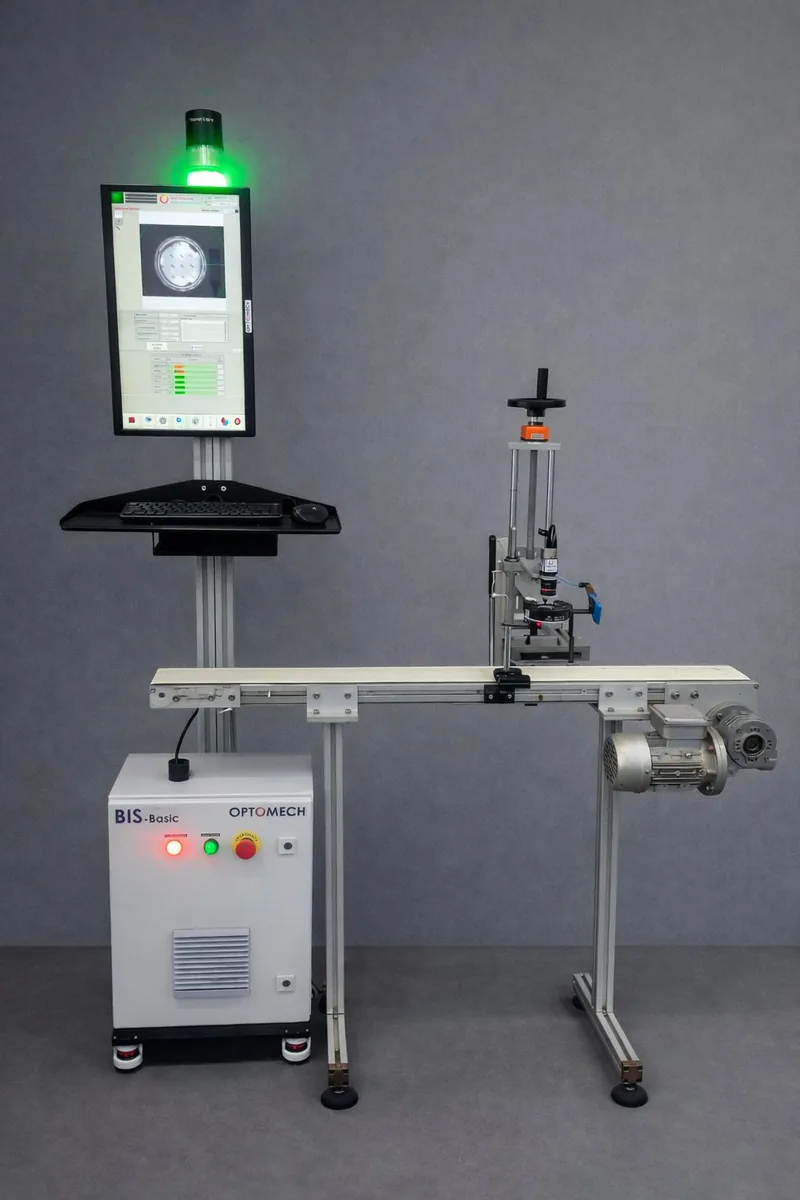
The BIS-SC is designed to work at the bottle manufacturer's plant and on the brand owner's filling line — delivering complete sealing surface quality control across the entire supply chain.
Place the BIS-SC at the output of your blow moulding or injection moulding line to catch sealing surface defects before bottles leave your plant. Send only conforming bottles to your customers — and back your quality with data.
Position the BIS-SC on your filling line — after the filling station and before the capping machine. It catches both pre-existing moulding defects and fresh contamination from the filling process.
The BIS-SC uses a single high-resolution industrial camera with specialised coaxial ring illumination aimed directly down at the bottle lip — delivering a perfect, shadow-free top-down image of the sealing surface on every bottle that passes beneath it.
The BIS-SC's AI-powered software analyses each top-down image of the sealing surface against a trained reference model. Any anomaly — whether a manufacturing defect or filling-line contamination — is flagged and the bottle is rejected automatically.
| Defect Source | Defects Detected on Sealing Surface |
|---|---|
| 🏭 Moulding Defects | |
| 🧴 Filling Contamination |
Note: Blue-tagged defects are detected when the BIS-SC is deployed on filling lines. All defects above are detected when deployed at the moulding plant output.
Everything in the BIS-SC is optimised for one purpose — ensuring every bottle that reaches the capping machine has a clean, defect-free sealing surface.
Advanced AI-based software analyses the complete sealing surface image in real time, distinguishing true defects from normal variation — minimising false rejects while catching every genuine fault.
Purpose-built coaxial LED ring lighting eliminates shadows across the narrow sealing surface, creating a uniform, high-contrast image that reveals even sub-millimetre defects like hairline cuts or trace contamination.
A large monitor displays the sealing surface image of every bottle in real time as it passes through inspection — with defect annotations, rejection counts, and trend statistics always on screen.
Each defect parameter has an adjustable tolerance limit, allowing quality teams to fine-tune sensitivity per product recipe. Accept or reject thresholds can be set separately for each defect type.
Store inspection settings for every bottle SKU in the recipe database. Switching between products requires selecting the saved recipe on the touchscreen — changeover takes seconds, not hours.
All inspection data, defect images, and batch statistics are stored in a database and can be retrieved at any time. Periodic reports are generated at user-defined frequencies — hourly, shift-wise, daily, or weekly.
Separate password-protected access for User, Supervisor, and Administrator roles — ensuring that only authorised personnel can modify inspection parameters, recipes, or system settings.
Optomech engineers can access the BIS-SC remotely for diagnostics, recipe optimisation, software updates, and troubleshooting — minimising downtime without waiting for an on-site visit.
The BIS-SC mounts directly over the existing production conveyor. No special bottle transport or line redesign is required in most installations — setup is fast and disruption to production is minimal.
The BIS-SC is designed for any product that is filled into a bottle, capped, and sealed. If the sealing surface is compromised, the product is at risk — regardless of the sector.
Tablets, capsules, syrups, suspensions, ophthalmic drops — regulatory compliance and patient safety demand a perfect seal every time.
Shampoo, conditioner, lotion, liquid soap — sealing failures cause in-transit leaks and shelf damage that result in consumer returns.
Protein powders, vitamins, health supplements — powder products are especially prone to contaminating the sealing surface during filling.
Pesticides, herbicides, fertiliser concentrates — a failed seal on a hazardous chemical container is a safety and liability risk.
Oils, sauces, vinegar, condiments — seal integrity is critical for food safety compliance and preventing spoilage in the supply chain.
Industrial lubricants, cleaning agents, adhesives — chemical product integrity and safe packaging compliance require verified sealing.
HDPE, PET, PP blow moulders and converters — supply defect-free bottles with full inspection data to differentiate in a competitive market.
Serums, toners, face washes — luxury product packaging demands zero visible defects and airtight sealing to protect formulations.
Designed and manufactured at Optomech's facility in Hyderabad, India. Specifications are subject to modification in the interest of product development.
| Parameter | Specification |
|---|---|
| Model | Optomech BIS-SC — Top Sealing Surface Inspection System |
| Application | 100% inspection of bottle top sealing surface (lip) — moulding lines and filling lines |
| Inspection Speed | Up to 7,000 bottles per hour |
| Bottle Height (max) | 230 mm |
| Bottle Diameter (max) | 110 mm |
| Min. Gap Between Bottles | 50 mm |
| Detection Accuracy | 0.2 mm (for bottle height up to 50 mm) |
| Number of Cameras | 1 high-resolution industrial camera with machine vision lens |
| Illumination | Specialised coaxial ring LED illumination — optimised for sealing surface imaging |
| Inspection Zone | Top sealing surface (bottle lip / neck finish) |
| Defects Detected | Flash, short moulding, cuts, black spots, material inclusions, diameter variation, product on lip, powder on lip |
| HMI | Large industrial monitor — real-time inspection images and statistics |
| Rejection System | Pneumatic automatic rejection |
| Access Control | 3-level: User / Supervisor / Administrator (separate passwords) |
| Software Compliance | 21 CFR Part 11 compliant |
| Data Storage | Full inspection database — all data and images retrievable at any time |
| Reporting | Periodic reports at user-defined frequency (hourly / shift / daily / weekly) |
| Machine Dimensions | Height: 1870 mm · Length: 604 mm · Width: 355 mm |
| Manufactured by | Optomech Engineers Pvt. Ltd., Hyderabad, India |
Watch the Optomech BIS-SC inspecting bottle top sealing surfaces live — real machine, real bottles, real production conditions.
Talk to an Optomech application engineer about deploying the BIS-SC on your moulding line or filling line. We'll assess your bottle formats, line speed, and defect requirements — and recommend the right inspection solution.
Optomech Engineers Pvt. Ltd. · 3A Type II, IE Kukatpally, Hyderabad 500 072 · +91 40 23078371