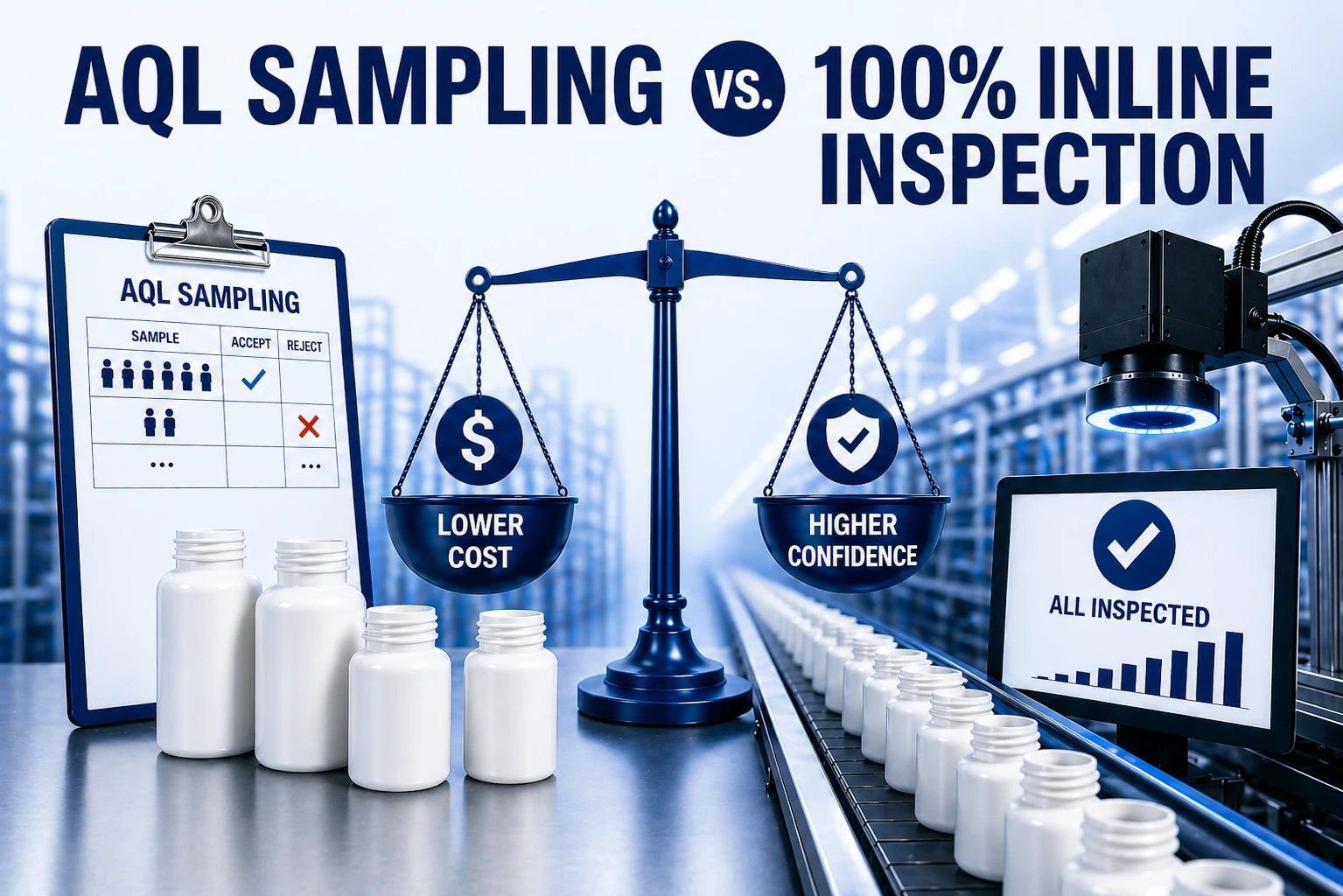
What AQL Actually Tells You
Acceptable Quality Level (AQL) is often misunderstood as a measure of how many defects you'll catch. It isn't. AQL is a lot acceptance criterion — a statistical threshold that tells you whether to accept or reject an entire batch based on a sample.
When you use AQL Level II with 1.0 AQL on a 2,500-piece lot, here's what actually happens:
- You inspect a sample of 125 pieces (5% of the lot)
- If you find ≤3 defects (the acceptance number, or c=3), you accept the entire lot
- If you find >3 defects, you reject the lot
- The remaining 2,375 pieces ship untested
The "1.0 AQL" doesn't mean 1% of your total output will be defective. It's a consumer's risk parameter — a probability threshold designed to protect the buyer by limiting the chance (to roughly 10%) that a marginally bad lot will be accepted.
This matters because a lot can fail AQL's acceptance criteria (say, 5 defects found in the sample of 125) and still ship as an accepted lot if the inspection plan allows it. The acceptance number is calibrated to balance cost of inspection against acceptable risk—not to catch every defect.
Key Insight
AQL measures lot-level acceptance probability, not individual defect detection. It was designed for incoming supplier inspection where 100% checking was prohibitively expensive. It was never designed for production line defect control.
The Defect Math Nobody Shows You
Let's put numbers to what "escaping defects" actually means in real-world conditions.
| Metric | AQL Level II (1.0 AQL) | 100% Inline Inspection (99.5% detection) |
|---|---|---|
| Lot Size | 2,500 pieces | 2,500 pieces |
| Sample Size | 125 pieces (5%) | 2,500 pieces (100%) |
| Acceptance Number (c) | 3 defects allowed | n/a (individual detection) |
| Defects that can pass at c=3 | Up to ~125 in uninspected lot | ~1.25 (0.5% escape rate) |
| At 10,000 bph line speed | 50–120 defects/hour shipped | 0–1 defect per 1,000,000 pieces |
| Cost per defect escaped | ₹150–300 in returns/claims | Virtually eliminated |
That gap isn't theoretical. At a typical pharma or FMCG packaging line running 10,000 bottles per hour:
- With AQL Level II: If your true defect rate is 0.1%, you're shipping 10 defects per hour to customers. Over a shift, that's 80 defects. Over a month, tens of thousands.
- With 100% inline inspection (>99.5% detection): Those same 10 defects per hour are detected and rejected. Escaped defects drop to near-zero.
Where AQL Genuinely Fails in Modern Packaging
AQL was designed in the 1940s for passive, random defects in purchased materials. Modern packaging lines have failure modes that AQL wasn't built to handle:
1. Intermittent Defects
A bottle capping line with a faulty servo that causes 1-in-200 bottles to have a loose cap. With AQL, the chances of catching that intermittent failure in your sample of 125 are low. Most escape undetected.
2. Clustered Defects
A molding cavity produces caps with slight warping. All caps from that cavity fail within a narrow time window. AQL sampling might catch zero from that batch if the sample happens to exclude the affected lot.
3. Cosmetic Variability
Print-on-label defects, slight color shifts, or surface blemishes that the customer may or may not accept. AQL doesn't distinguish "acceptable variation" from "defect" — it just counts yes/no. Your customer might reject 30% of what AQL called acceptable.
4. Seal Failures (Not Always Visible)
An induction seal that looks intact under visual inspection but has micro-cracks. Pressure test or thermal imaging would catch it; visual sampling won't. AQL sampling misses these entirely.
Common Failure Pattern
Most customer complaints about "defects that passed inspection" fall into one of the above categories. AQL's random sampling model can't handle systematic or intermittent failures — and modern production lines generate exactly those kinds of defects.
What Most People Get Wrong About AQL
The biggest confusion: confusing AQL as a supplier qualification tool with AQL as a production quality control tool.
Supplier Qualification (Incoming Inspection): You're receiving shipments from an external vendor. You can't inspect 100% of everything they send. AQL tells you: "If I sample this shipment and find ≤3 defects in 125 pieces, I'll accept this vendor's lot." AQL works here because you're making a binary lot-acceptance decision based on risk tolerance.
Production Quality Control: You're running your own line. You have visibility into every piece. Using AQL here is like checking 5% of your cards on the assembly line and shipping the rest "on faith." Why would you?
Yet many pharma and FMCG plants still use AQL-based sampling for their own production lines, then act surprised when customer complaints rise. The standard has drifted — what was designed for supplier management became mistakenly applied to production control.
When AQL Still Makes Sense
This isn't an article saying "AQL is useless." It's useful in the right context:
- Raw Material Incoming Inspection: You're receiving resins, labels, or caps from a supplier. 100% inspection is impractical. AQL sampling is appropriate.
- Spare Parts Procurement: You're buying replacement motors or sensors in bulk. AQL-based acceptance is reasonable.
- Non-Critical Components: Items where a single defect doesn't trigger customer returns or regulatory issues. AQL can work if the cost of 100% inspection exceeds the cost of occasional escapes.
- Cost-Constrained Legacy Systems: If you genuinely can't afford inline inspection hardware, AQL sampling is better than no inspection.
The point: Use AQL where it was designed — for incoming inspection and supplier qualification. Not for production control.
Want to see what 100% inspection actually catches on your line?
We'll demonstrate it live on your packaging line — no obligation. See the defect classes your current sampling plan is missing.
Schedule a DemoThe Business Case for Switching
If AQL sampling costs you ₹5 per lot but allows 10 defects per hour to escape, and each escaped defect costs ₹200 in customer returns and reputation damage, the math is clear.
A real case: A pharma bottling plant in Hyderabad was running at 12,000 bph with AQL Level II sampling. Their true defect rate (detected post-customer) was 0.08%. They shipped approximately:
- 9.6 defects per hour × 8-hour shift = ~77 defects per shift
- 77 defects × ₹368 avg. cost per return = ~₹28,400 per shift in returns
- Over a month (25 working days, 2 shifts): ₹28.4 lakhs in direct return costs
After deploying 100% inline inspection (Optomech Bottle Inspection System with >99.5% detection), escaped defects dropped to 0.04% (roughly 1 per 2,500 bottles). Returns fell by 87%. The system paid for itself in under 8 months.
The cost isn't just financial. Regulatory bodies (CDSCO, WHO), retailers, and customers expect pharmaceutical and food packaging to have near-zero defect rates. AQL sampling no longer meets modern quality expectations in regulated industries.
Practical Takeaway
Here's the decision tree:
- Are you receiving goods from an external supplier? → Use AQL-based sampling for lot acceptance.
- Are you running your own production line? → Use 100% inline inspection.
- Are your customers regulated (pharma, food, medical devices)? → 100% inspection is the standard, not optional.
- Can you afford inline hardware? → The ROI is positive within 6–18 months in high-speed lines.
- Do you face customer complaints about defects? → Your AQL sampling plan isn't catching them. Inline inspection will.
AQL sampling is a tool from a different era of manufacturing—one where 100% inspection was prohibitively expensive and customers accepted occasional defects. Modern packaging lines, modern customers, and modern regulatory bodies expect better.