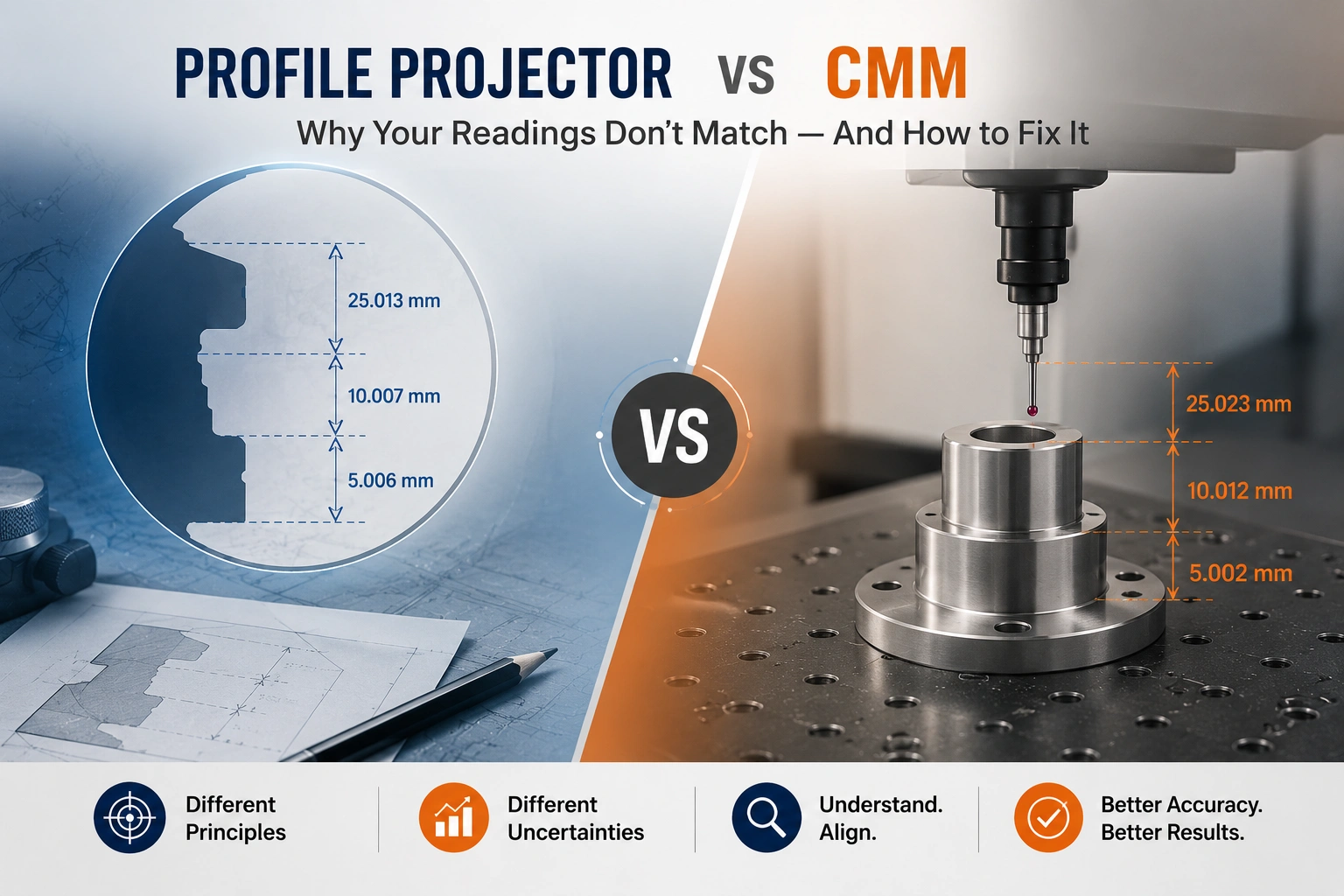
The Problem Is More Common Than You Think
Every production metrology team has faced this at some point. A batch of turned components is measured on the shop-floor profile projector and passes. The same batch goes to the quality lab, gets put on the CMM, and three parts show a borderline dimension. Now you have a dispute — the customer's lab uses a CMM, your shop floor uses a profile projector, and the numbers differ by 20–40 µm.
The automatic assumption is that one instrument is miscalibrated or the operator made an error. That assumption is almost always wrong. Both instruments can be correctly calibrated and correctly used — and still produce different numbers on the same dimension.
Understanding why this happens is the first step to resolving it — and to building a measurement system that does not create disputes in the first place.
Root Cause 1: Edge Detection — Optical vs Tactile
This is the single largest source of discrepancy between a profile projector and a CMM, and it is rarely discussed clearly.
A CMM with a ruby probe makes contact at a precisely defined point. The probe triggers at a defined deflection force (typically 0.1–0.5 N). The contact point is at the physical surface.
A profile projector measures the edge of the optical silhouette — not the surface directly. The optical edge is the point where light transitions from shadow to illumination. In a perfect telecentric system, this edge corresponds precisely to the geometric edge of the part.
In practice, several things create a penumbra — a soft, diffuse transition zone at the edge rather than a sharp step. This penumbra can be 5–20 µm wide, and wherever the software or operator places the edge cursor within that zone determines the measured dimension.
The key insight: If your profile projector uses manual cursor placement to define edges (no software edge detection), operator-to-operator variation of 10–30 µm on the same part is normal — not a calibration problem.
What Causes Optical Edge Penumbra
- Non-telecentric optics: A conventional lens projects edges slightly differently depending on where the part sits in the field of view, creating parallax. Telecentric lenses eliminate this entirely.
- Surface finish: A burr, chamfer radius, or surface roughness at the edge creates a diffuse optical boundary instead of a sharp step.
- Illumination intensity: Over- or under-exposure affects the apparent edge position by shifting the light-to-dark transition threshold.
- Focus: Even slight defocus spreads the optical edge, making cursor placement less reproducible.
Root Cause 2: Datum Setup Differences
A dimension is meaningless without a datum. The CMM and the profile projector are almost certainly not using identical datum setups — and if they are not, they are measuring different things, even if the nominal drawing calls out the same feature.
On a CMM, datum planes are established by probing a specified set of reference surfaces in a defined sequence. The resulting coordinate frame is mathematically determined.
On a profile projector, the part is placed on the stage table. The datum is established by how the part physically rests. Any misalignment — even a few microns of tilt — shifts all measured dimensions when features are measured relative to an edge or axis.
Practical check: If two instruments agree on diameter but diverge on position measurements, datum setup is the root cause, not edge detection.
Root Cause 3: Thermal Expansion Between Measurements
This is especially relevant in India, where shop floor temperatures can be 30–38°C while the quality lab is typically at 20–23°C.
The linear thermal expansion coefficient of steel is approximately 12 µm/m/°C. A 100 mm steel shaft measured 15°C warmer on the shop floor will be approximately 18 µm longer than the same shaft measured in a temperature-controlled lab.
For a 20 mm feature, the difference across a 15°C temperature change is roughly 3.6 µm. Small — but for tolerances of ±10 µm, that is 36% of the tolerance band consumed by thermal expansion alone.
ISO 1: The international standard for dimensional measurement specifies 20°C as the reference temperature. A measurement made at 34°C cannot be directly compared to one made at 20°C without applying a thermal correction factor.
Root Cause 4: Feature-Specific Measurement Differences
Not all features are equally well-suited to both measurement methods. The mismatch becomes systematic when the wrong method is used for a given feature type.
| Feature Type | Profile Projector / VMM | CMM | Notes |
|---|---|---|---|
| 2D profile / outline | ✅ Excellent | ⚠️ Point-by-point | Optical captures full edge in one view |
| External diameter | ✅ Excellent (telecentric) | ✅ Excellent | Agree well when both properly set up |
| Thread profile / pitch | ✅ Excellent | ⚠️ Limited by probe geometry | Optical is the better method here |
| Small radius / fillet | ✅ Excellent | ⚠️ Probe size limits access | Optical captures sub-0.5 mm features |
| True position (3D) | ⚠️ 2D only | ✅ Full 3D | CMM is the reference for 3D features |
| Internal bore depth | ❌ Line-of-sight limited | ✅ Excellent | CMM required for deep internal features |
| Soft/deformable parts | ✅ Non-contact — no deformation | ⚠️ Probe force causes deformation | Optical is more accurate here |
Optomech's applications engineers help manufacturers set up a measurement system agreement — defining which instrument is the reference for each feature type.
What Most People Get Wrong
The standard response to a profile projector vs CMM discrepancy is to "recalibrate both instruments." This is almost always the wrong action.
Calibration verifies that the instrument measures a known reference standard correctly. If both instruments pass their calibration checks, the discrepancy is not a calibration problem. Sending both for recalibration will cost time and money — and the discrepancy will still exist when the instruments return.
The actual resolution path requires understanding measurement system correlation — a formal process of aligning two measurement methods so they produce comparable results on the same feature. This is distinct from calibration.
Calibration = verifying an instrument against a traceable reference standard.
Measurement system correlation = ensuring two different instruments agree on the same
part feature, using a defined measurement protocol.
Recalibrating does not fix a correlation problem.
How to Actually Fix It: A Practical Framework
-
Identify which instrument is the reference standard for each feature. Do this based on measurement principle, not habit. CMM is the reference for 3D features. Optical is the reference for 2D profiles, threads, small radii, and non-contact features on deformable materials.
-
Use a calibrated reference part — not just a standard. Have a certified reference component made from the actual production part material and measured on an NPL- or NABL-traceable CMM. Use this as the cross-instrument reference artefact for both instruments.
-
Standardise the measurement protocol for both instruments. Document datum setup, probe sequence for the CMM, part orientation for the projector, temperature soak time, illumination setting, and edge detection threshold. Both operators must follow the same protocol.
-
Switch to software edge detection on the optical system. Manual cursor placement is inherently operator-dependent. Profile projectors with integrated measurement software (such as Optomech's OP1000) use algorithm-based edge detection at a defined grey level threshold — eliminating operator variation entirely.
-
Apply thermal correction or temperature-soak the parts. If the CMM is in an air-conditioned lab and the profile projector is on the shop floor, bring parts to the CMM lab for 30 minutes before measuring, or apply the thermal correction factor based on the measured temperature difference.
-
Run a formal Gauge R&R correlation study — not a single comparison. One comparison measurement tells you almost nothing. A proper correlation study uses 10 parts across the tolerance range, measured 3 times by 2 operators on each instrument. This gives you the actual bias and repeatability of the correlation.
When a Profile Projector Will Never Agree With a CMM
There are cases where the disagreement is structural — neither instrument is wrong, but they fundamentally cannot produce the same number:
- Features with geometric form errors: If an "external diameter" has ovality, a CMM measures the diameter at a specific cross-section angle, while an optical system measures the projected shadow — which is the maximum diameter. These are different measurements.
- Features with surface texture at the edge: On ground or honed surfaces, the optical edge includes surface peaks while the CMM probe averages across the surface. The difference is systematic and correlates with surface roughness Ra.
- 3D features measured in 2D projection: An angled hole, chamfer, or compound profile looks different in 2D projection than it measures in 3D space. A profile projector cannot replicate CMM 3D measurement for such features.
In these cases, the correct resolution is to establish a measurement system agreement with your customer that specifies which measurement method is the contractual reference — not to argue about which instrument is more accurate.
Upgrading the Optical System: When It Makes Sense
If you are consistently facing profile projector vs CMM discrepancies in production, the root cause is often an older optical system without:
- Telecentric optics (parallax-free edge detection)
- Software-based automatic edge detection
- Temperature-compensated stage
- NABL-traceable calibration artefacts
Modern profile projectors with telecentric lenses and digital measurement software — such as the Optomech PP 300TE — reduce edge detection uncertainty to below ±2 µm, making cross-instrument correlation substantially easier to achieve.
For higher volumes, a Vision Measuring Machine (VMM) with CNC-programmable part programs eliminates operator variation entirely, making correlation to a CMM far more reproducible.
Practical Takeaway
Profile projector vs CMM discrepancy is a measurement system design problem, not a calibration problem. Resolve it by:
- Assigning each feature type to its appropriate instrument
- Standardising the measurement protocol across both instruments
- Switching to software edge detection on the optical system
- Running a formal correlation study — not a one-off comparison
- Temperature-stabilising parts before measurement
If you have a specific correlation problem between an existing instrument and a customer's CMM, the Optomech applications team has worked through this scenario across automotive, aerospace, and pharma manufacturing environments in India. The resolution path is structured and well-documented.