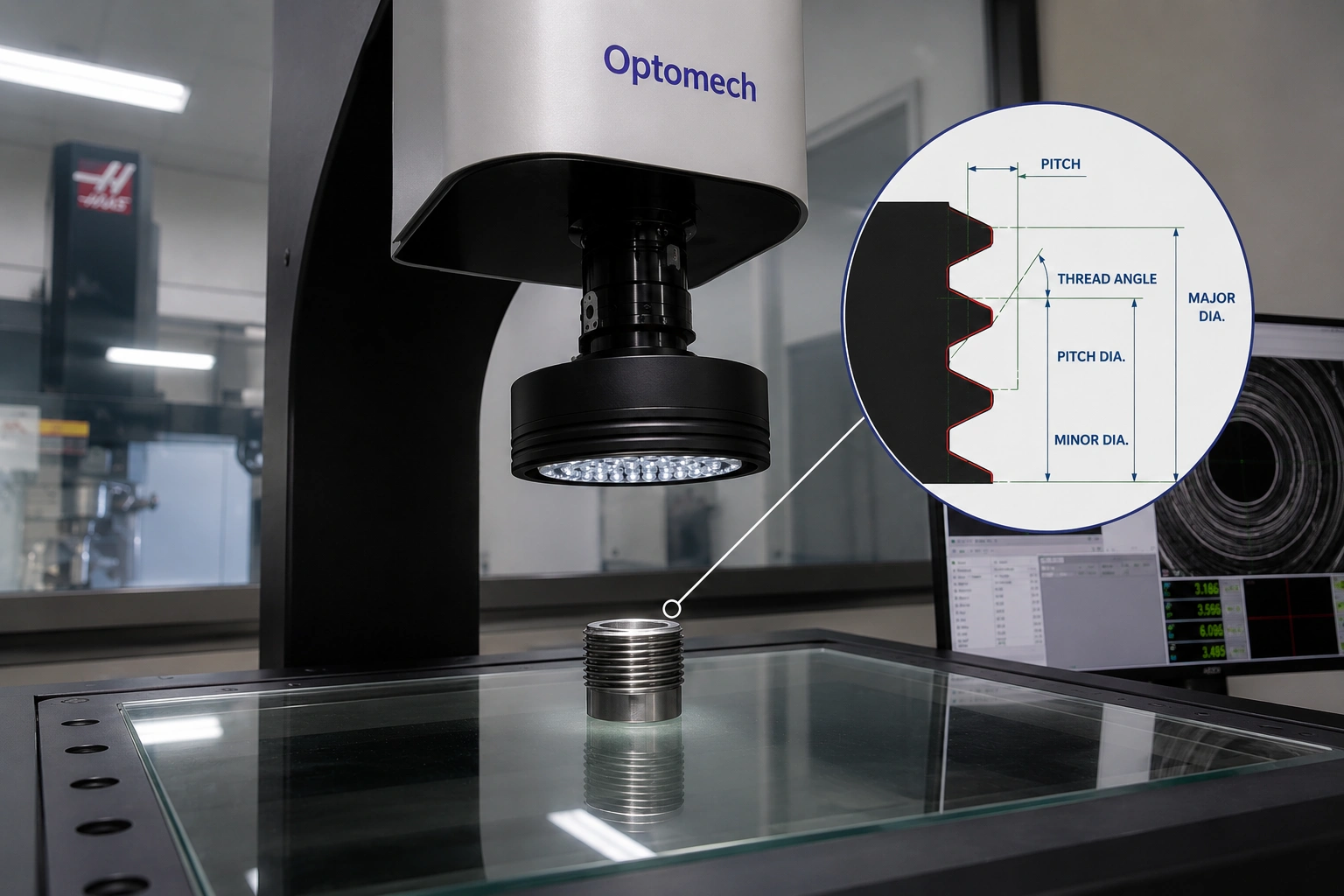
Walk into almost any machine shop in India inspecting threaded parts and you'll find the same setup: a technician with a set of thread ring gauges and plug gauges, working through a pile of components. The gauge goes in — or it doesn't. Pass or fail. No data. No trend. No warning.
This approach made sense when optical measurement systems were slow, expensive, and required a metrology lab. That constraint no longer exists. Modern profile projectors and vision measuring machines measure thread pitch, flank angle, form profile, and effective diameter in under 60 seconds — on the shop floor, at production temperature, with output feeding directly into your SPC system.
The question is no longer whether optical thread inspection is feasible. It's whether your current process is giving you the information you actually need to control quality.
What Manual Thread Gauges Actually Measure
A go/no-go gauge assesses functional size — specifically, the effective diameter of the thread in the context of mating geometry. A plug gauge goes in = the internal thread is within functional limits. A ring gauge engages = the external thread is within functional limits.
This is useful. But it is not the same as knowing:
- Whether the pitch error is accumulating across multiple turns (lead error)
- Whether the flank angle is 59.5° instead of 60° — technically within gauge limits but mechanically weaker
- Whether the root radius is too sharp, creating a stress concentration point that will cause fatigue failure in service
- Whether crest truncation is eroding the effective load-bearing contact area
- Whether the thread form is drifting gradually over a production run — the gauge still passes, but by a shrinking margin
Thread gauge results are binary. Thread profile measurement is continuous. For quality systems that need SPC, process capability (Cpk), or IATF 16949-compliant measurement records, binary data is not enough.
A threading tool wears gradually. Go/no-go gauges detect the failure endpoint — when a part finally falls outside functional limits. Optical measurement detects the drift 50–200 parts earlier, while the deviation is still within tolerance but moving toward rejection. The difference is a scrapped batch versus a tool change at the right time.
What Optical Thread Profile Inspection Measures
A profile projector or VMM measuring thread form captures a magnified optical image of the thread cross-section and applies measurement algorithms to extract dimensional data from the silhouette or reflected image.
Pitch & Lead
Cumulative and individual pitch error across multiple thread turns. Lead error detected over the full thread length.
Flank Angle
Both flank angles measured independently. Asymmetric wear — common in single-point threading — detected immediately.
Thread Form Profile
Actual profile overlaid on nominal. Root radius, crest truncation, and form deviation quantified vs drawing requirement.
Thread Height / Depth
Actual thread height vs nominal. Shallow threads that pass gauge but have reduced load capacity are flagged.
Major & Minor Diameter
Optical measurement of thread diameters without probe contact — no risk of marking threaded surfaces.
SPC Data Export
Every measurement feeds your SPC system. Trend alerts before any part reaches the reject boundary.
Profile Projector vs Vision Measuring Machine for Thread Inspection
Both instruments can measure thread profile. The choice depends on your production volume, part complexity, and whether thread measurement is the primary or secondary function of the instrument.
| Criterion | Profile Projector | Vision Measuring Machine (VMM) |
|---|---|---|
| Thread Form Measurement | Excellent — large projected image, easy overlay comparison | Excellent — automated edge detection, no overlay required |
| Measurement Automation | Semi-automatic with digital readout | Fully automated CNC programs — operator loads, machine measures |
| Multi-Feature Parts | Thread + limited 2D features | Thread + full 2D feature suite in one setup |
| Throughput | Moderate — operator-paced | High — 15–25 features per part in under 60 seconds |
| Operator Skill Required | Medium — overlay interpretation training needed | Low — CNC programs eliminate operator subjectivity |
| Investment | Lower entry cost — suited for dedicated thread inspection | Higher — justified when multiple features measured together |
| SPC Integration | RS-232 / digital export available | Native SPC software integration, LAN data feed |
| Best For | Dedicated thread QC, job shops, tool room inspection | Production lines measuring threads + other features on same part |
If threaded fasteners, studs, or shafts are your primary product and thread form is the main inspection requirement, a profile projector delivers the best value — lower cost, simpler operation, excellent measurement capability. If threads are one feature among many on a complex turned part, a VMM handles everything in a single setup and eliminates the need to move parts between instruments.
Measure Your Thread Profile — See the Data Gauges Don't Give You
Send us a sample or drawing. We'll run optical thread profile inspection and show you exactly what your gauge can't tell you.
Industries Where This Shift Is Happening
Automotive & Auto Ancillary
IATF 16949 requires documented measurement system analysis (MSA) and SPC. Go/no-go gauges typically cannot satisfy MSA requirements for variable data. Optical measurement provides the variable data that supports gauge R&R studies, Cpk reporting, and PPAP dimensional documentation — requirements that manual gauging simply cannot meet on its own.
Fastener Manufacturing
Fastener plants producing tens of thousands of threaded components per day have the most to gain from optical inspection. The volume justifies automation; the gauge wear risk is highest at this scale; and the cost of a customer complaint on functional thread failure — in automotive or infrastructure applications — dwarfs the cost of the measurement system.
Aerospace & Defence Components
For critical threaded joints — locking fasteners, hydraulic fittings, actuator threads — the dimensional record requirement alone justifies optical measurement. AS9100 and NADCAP-regulated supply chains require traceability to measurement records that a gauge stamp cannot provide. Optical systems generate the measurement file; gauges generate a tick in a box.
Medical Devices & Surgical Instruments
Bone screws, implant fixings, and surgical instrument threads require full profile documentation for ISO 13485 compliance and regulatory submission. Gauging-only inspection is increasingly challenged by auditors in this sector. Optical measurement records are accepted as evidence of controlled inspection processes.
What Most People Get Wrong About Thread Inspection
The common misconception is that if the gauge passes, the thread is acceptable. This is true for functional assembly — but not for the downstream questions that matter most in a quality-managed environment:
- Process stability: A gauge cannot tell you whether your Cpk is 1.33 or 0.95. Both can produce passing parts — until they don't.
- Root cause: When a batch fails, gauging gives you a count. Optical inspection gives you the specific parameter that failed and its magnitude — the data you need to correct the process rather than just screen parts.
- Gauge wear: Thread gauges wear and drift themselves, requiring periodic calibration. During the interval between calibration cycles, a worn gauge may pass parts that a calibrated gauge would reject. Optical measurement against a calibrated NABL-traceable standard removes this variable.
- Sampling risk: For critical applications, 100% optical inspection at production speed is achievable. 100% manual gauging is not — it is slow, fatiguing, and subject to operator error rates that increase with time on task.
A well-maintained go/no-go gauge has a gauge R&R of effectively 0% — it measures nothing variable, so there is no measurement variation to report. This is sometimes cited as an advantage. In practice, it means the gauge provides no information about process capability, no early warning of drift, and no data for process improvement. Optical thread measurement typically achieves 4–8% gauge R&R on thread pitch and flank angle — providing variable data that supports genuine process control.
Setting Up Optical Thread Inspection on the Shop Floor
The practical objection to optical thread measurement is always setup complexity. Here is what the actual process looks like:
- Part mounting: External threaded parts are placed on a V-block or between centres with the thread axis horizontal to the optical axis. Setup takes under 60 seconds for standard shafts and studs.
- Program loading: For repeat parts, a pre-stored CNC program is recalled by part number. The machine executes all measurements automatically — no operator intervention required during the measurement cycle.
- Measurement: Pitch, flank angles, form profile, and diameters are measured and compared to nominal tolerances. A pass/fail report is generated with actual values.
- Data export: Results feed to SPC software, ERP, or shared network folder in real time. No manual data entry, no transcription error.
For a production line running a single part number, total operator time per piece is typically under 90 seconds including handling. For a job shop with multiple part numbers, program recall adds 10–15 seconds per changeover. Neither represents a practical throughput constraint.
Practical Takeaway
Manual thread gauges are not going away — they remain useful for quick functional checks at the machine and for final assembly verification. But for production QC that needs to feed SPC, satisfy IATF or ISO 13485 documentation requirements, or provide actionable process feedback, gauges are insufficient.
The practical path for most manufacturers is hybrid: optical measurement as the primary production inspection tool generating variable data for SPC, with go/no-go gauge confirmation as a secondary check at critical assembly points. The optical system controls the process; the gauge confirms the outcome.
If your current thread inspection is gauge-only and you are already operating under IATF 16949, NADCAP, or ISO 13485, you are likely one customer audit away from a finding on measurement system adequacy. Optical inspection resolves that gap while simultaneously improving your ability to control thread quality — not just screen for rejects.
Begin with your highest-volume threaded part number — the one where tool wear is most costly, where customer returns have occurred, or where SPC reporting is already expected. Profile projectors start at a lower investment than most manufacturers expect, and the data collected in the first production run typically demonstrates ROI clearly enough to justify the decision without further analysis.