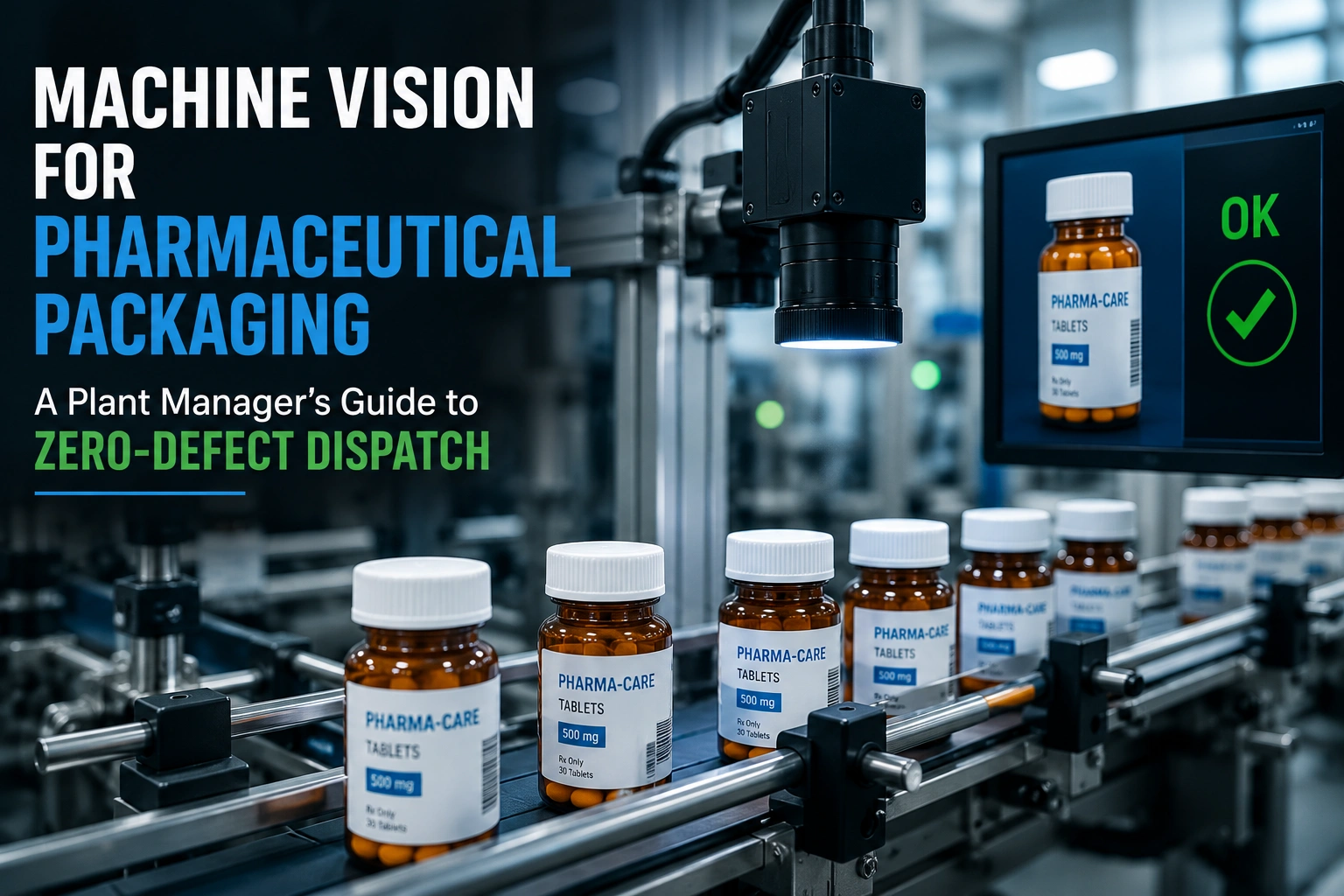
The pharmaceutical packaging line is arguably the highest-stakes quality control environment in Indian manufacturing. A missing induction seal on a syrup bottle isn't a cosmetic defect — it's a contamination pathway. A misaligned label with an obscured batch number isn't a print quality issue — it's a regulatory non-conformance that can trigger a market recall.
Despite this, many mid-size pharma plants still rely predominantly on manual inspection at speeds where the human visual system is provably unreliable. Research consistently shows that manual inspectors miss 15–35% of defects under normal operating conditions — and detection rates decline further with fatigue across a shift.
Machine vision doesn't get tired. It doesn't have a bad shift. At 200 containers per minute, it applies the same algorithm to every unit with the same sensitivity. That's not a marketing claim — it's the functional basis on which regulatory bodies and quality systems increasingly require automated inspection evidence.
What Machine Vision Actually Inspects on a Pharma Packaging Line
The answer depends on how the system is configured and where cameras are placed. A well-designed inspection architecture covers these stations:
Induction Seal Integrity
Detects missing, torn, wrinkled, or incompletely bonded foil seals before the cap is applied — or after, using infrared or reflective imaging.
- Seal presence confirmation
- Seal coverage area check
- Wrinkle and fold detection
- Pinhole detection (with IR imaging)
Cap Inspection
Verifies that caps are present, correctly seated, and at the right torque angle — critical for tamper evidence and closure integrity.
- Cap presence / missing cap
- Cap seating angle (tilt detection)
- Skewed or cross-threaded caps
- Cap type / colour verification
Label Inspection
Goes beyond "is the label there" — verifies placement accuracy, print content, barcode readability, and expiry date presence.
- Label presence and placement position
- Barcode / QR code readability
- Expiry date and batch number presence
- Label wrinkle and bubble detection
Fill Level Verification
Checks that liquid fill volumes are within tolerance — underfills and overfills both represent quality non-conformances and regulatory exposure.
- Liquid level detection (transmission or reflection)
- Low-fill and overfill rejection
- Foam detection for liquid products
- Empty container detection
Container Integrity Check
Screens for physical damage to bottles, vials, or ampoules — cracks, chips, deformations — that could compromise containment.
- Neck and shoulder crack detection
- Chipped rim inspection
- Sidewall deformation check
- Base defect detection
Carton and Secondary Pack
Verifies that outer cartons are correctly printed, closed, and contain the right number of primary containers — reduces misdispensing at the dispensary level.
- Carton flap closure check
- Outer carton print verification
- Pack count confirmation
- Insert / leaflet presence check
Most Indian pharma plants that have implemented machine vision started with a single station — typically induction seal or cap inspection — and expanded coverage after demonstrating ROI on the first station. You don't need to instrument every station at once. Start where your defect data shows the highest escape risk.
Manual Inspection vs Machine Vision: An Honest Comparison
Manual inspection isn't without merit — an experienced operator can detect defects that a poorly configured vision system misses, particularly novel or complex defects not in the training set. But it has fundamental limitations at production line speeds.
| Criterion | Manual Inspection | Machine Vision |
|---|---|---|
| Throughput capacity | 20–40 units/min (reliable) | 100–400+ units/min |
| Defect detection consistency | Declines with fatigue; 65–85% detection typical | Consistent 99%+ on configured defect types |
| Audit trail / data logging | Manual records — often incomplete | Automated per-unit data log |
| Novel defect detection | Experienced operators adapt | Requires retraining / reconfiguration |
| cGMP documentation compliance | Possible but resource-intensive | Automated; supports 21 CFR Part 11 / Schedule M |
| Operating cost (long-term) | Labour cost + training + turnover | Fixed asset + maintenance |
| Variability between shifts | High — operator-dependent | Zero — same algorithm every shift |
Assessing Inspection Gaps on Your Packaging Line?
Our vision systems team can audit your current packaging line and identify the highest-risk inspection gaps. No obligation assessment available for pharma manufacturers.
Regulatory Context: What CDSCO and WHO-GMP Expect
Revised Schedule M — which has been progressively enforced for medium and large manufacturers from 2024 onward — requires an effective system to detect and prevent the release of non-conforming products. It specifically mandates documentation of visual inspection procedures and their effectiveness.
The critical phrase is "effectiveness." Regulatory inspectors are increasingly asking for data that demonstrates a manufacturer's inspection system actually works — detection rates, rejection statistics, correlation between inspection rejections and confirmed defect rates, and audit trails. This is where manual inspection creates a systemic audit vulnerability: it generates very little objective data about its own effectiveness.
Machine vision systems, by contrast, generate:
- Per-unit pass/fail records — traceable to batch, time, and inspection station
- Rejection logs with defect classification and images
- Statistical summaries of defect rates by type, shift, and line
- System qualification records (IQ/OQ/PQ) as required by cGMP validation frameworks
- Audit-ready reports exportable for CDSCO and WHO-GMP inspections
WHO Prequalification audits and USFDA inspections of Indian pharma facilities have been increasingly citing inadequate container closure inspection as an observation — particularly for liquid and injectable products. Exporters targeting regulated markets cannot rely on manual inspection as their primary mechanism for closure integrity verification. Machine vision is the standard expected approach at facilities audited against these frameworks.
What Most Plant Managers Get Wrong When Deploying Vision Systems
Mistake 1: Treating all defects as equally detectable. A machine vision system is only as good as its configuration for the specific defect type and product. A system correctly set up to detect missing caps may not detect a subtly skewed cap without a dedicated tilt-detection algorithm. During system commissioning, define an exhaustive defect library for your specific product range — and test each defect type explicitly during Operational Qualification.
Mistake 2: Optimising only for false negatives. A system that misses defects is dangerous, but a system with an excessively high false reject rate kills line efficiency and operator confidence. Both parameters matter. The target is a properly tuned system that detects defined defects reliably while maintaining acceptable good-product throughput. This tuning work happens during PQ — not after go-live.
Mistake 3: Setting and forgetting. Machine vision systems are not passive instruments. They require periodic requalification when packaging materials change (new label stock, new foil, new bottle colour), when line speeds change, or when new product variants are introduced. Many plants discover this during a regulatory audit, not during routine operations — which is a poor time to discover it.
Mistake 4: Assuming camera coverage = inspection coverage. A camera pointed at a label only inspects what the lens can see. Bottles rotating on the line, label wrap positions, and background lighting all affect what is actually visible to the sensor. Good system design engineers the inspection geometry — not just the camera placement.
A Practical Implementation Checklist
For plant managers evaluating or preparing for machine vision deployment:
- Define your defect library before vendor discussions — know specifically what you need to detect
- Audit existing line speed; confirm the vision system is rated for your maximum throughput with margin
- Plan for IQ/OQ/PQ documentation from the start — not as an afterthought post-installation
- Ensure your vision vendor can supply cGMP validation support documentation
- Test with real defect samples (deliberate defect kits) during OQ — not simulated images
- Configure data logging to export in a format compatible with your batch management or MES system
- Define requalification triggers in your SOP: material changes, speed changes, product changes
- Do not accept "adjustments after go-live" as a substitute for proper PQ sign-off
- Do not set reject sensitivity so high that false rejects become a default line-stop mechanism
Practical Takeaway
Machine vision on a pharmaceutical packaging line is not a cost — it's a risk reduction mechanism that happens to pay for itself. The direct costs of a market recall, a regulatory observation, or a customer complaint in a regulated market vastly exceed the cost of the inspection system that prevents it.
The question is not whether your packaging line needs machine vision. For any pharma plant operating at speeds above 60–80 units per minute, the answer is already yes. The question is which inspection stations carry the highest risk for your specific product portfolio — and that's where you deploy first.
Seal integrity and cap inspection are the entry points for most facilities. Label verification follows. From there, a systematic coverage expansion, informed by your own rejection and complaint data, builds an inspection architecture that satisfies both operational quality and regulatory audit requirements.