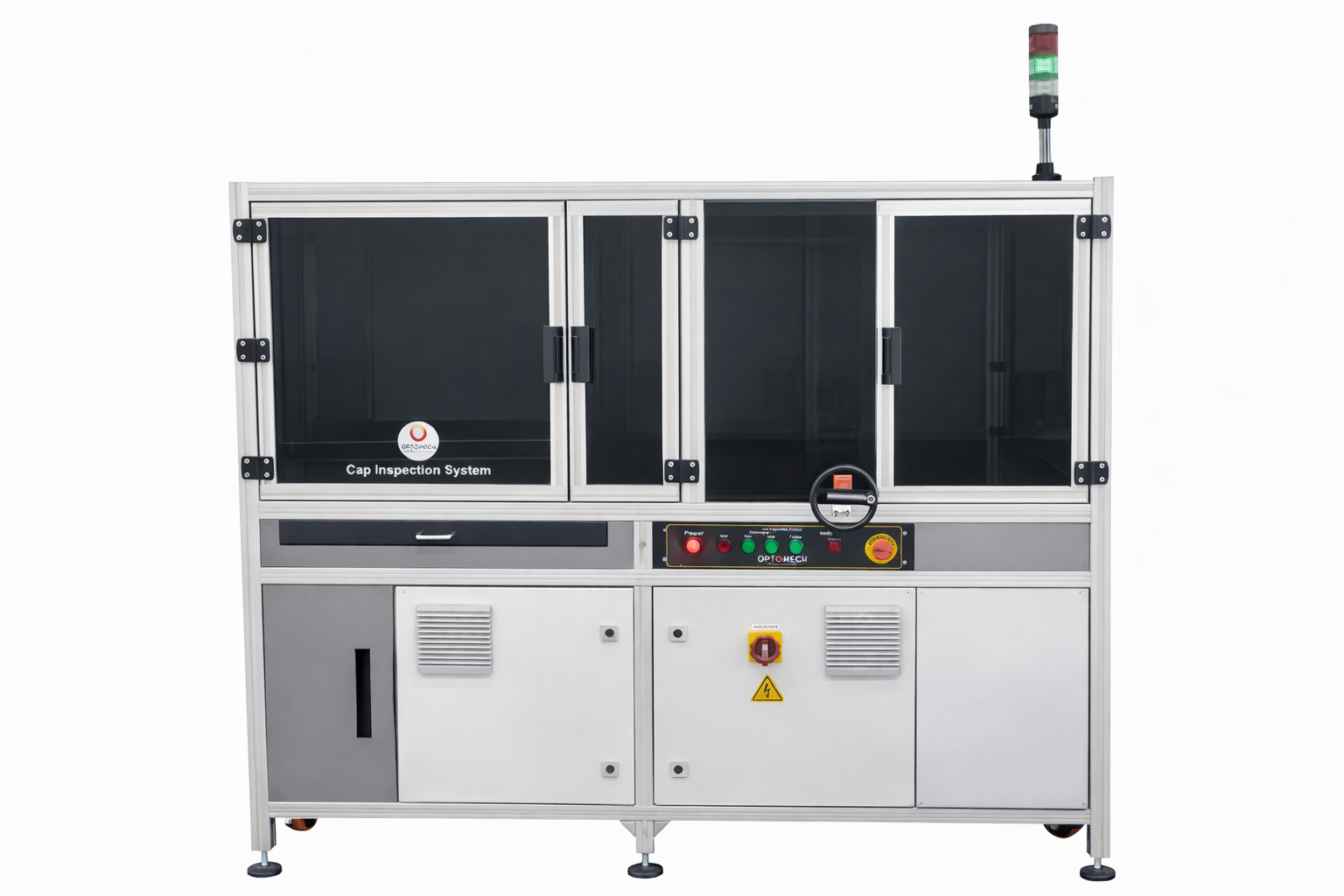
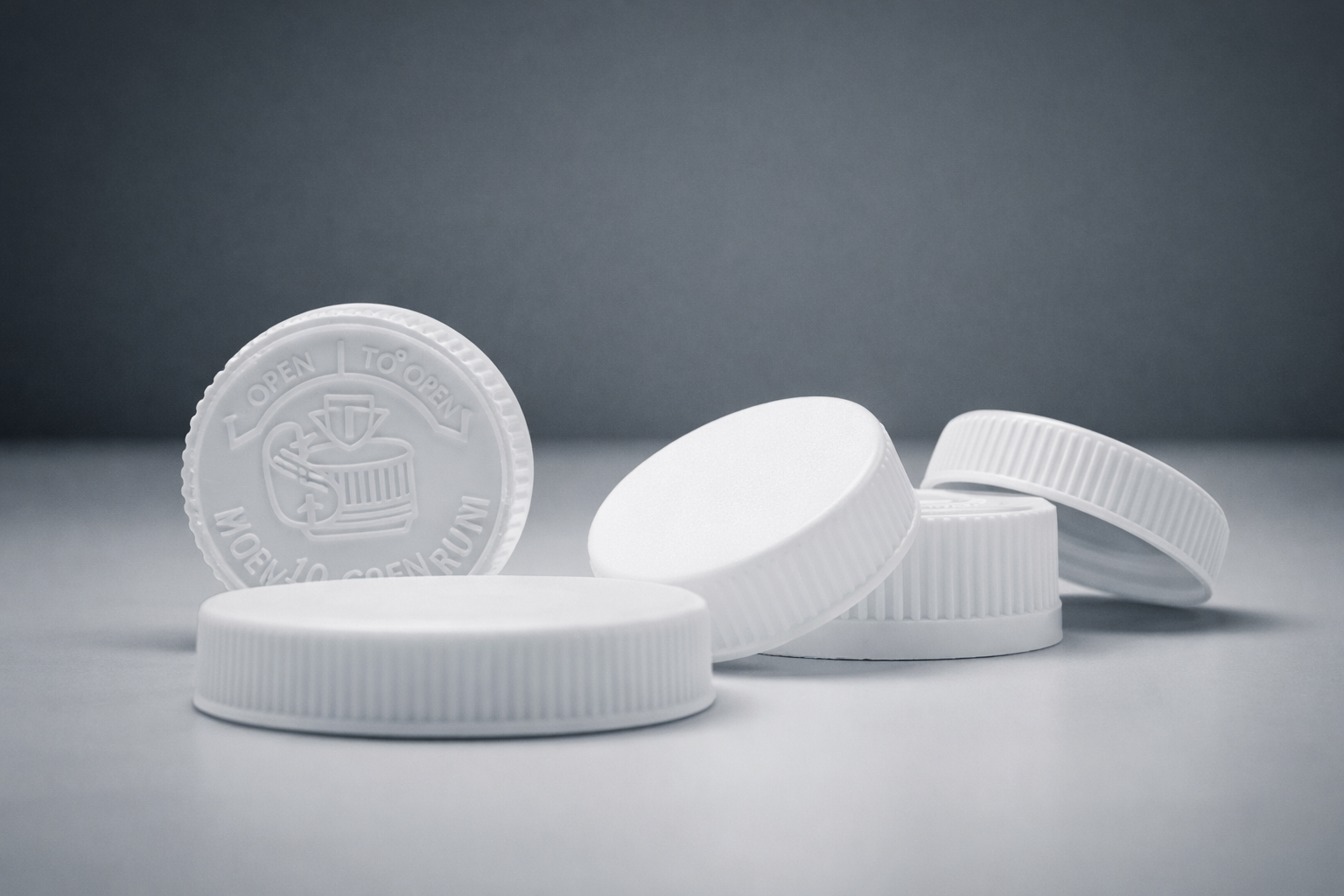
100% automated vision inspection of every cap and closure on your production line — before a single defective cap reaches the bottling machine. Three purpose-built systems for pharmaceutical, FMCG, and plastic cap manufacturers.
In cap moulding and bottling, defects like missing liners, flash, short moulding, and contamination arise constantly — due to temperature variations, raw material inconsistencies, and mould wear. Manual inspection cannot keep pace with modern production speeds. The result: defective caps on filled bottles reaching your customers.
Even experienced manual inspectors miss defects under production fatigue. A single missing liner on a pharmaceutical bottle compromises product safety, shelf life, and regulatory compliance.
In pharmaceutical applications, a cap without a liner means induction sealing will fail — and that bottle reaches the patient without a tamper-evident seal, violating GMP requirements.
Deploying 2–4 manual inspectors per shift for cap inspection costs 4× more over three years than a CIS system — with inconsistent results and no digital traceability.
The Optomech CIS never gets tired, never misses a defect type it is configured for, and generates a complete digital record of every cap inspected — shift after shift, product after product.
The Optomech CIS range covers the full spectrum of cap and closure inspection requirements — from standard pharmaceutical liners to complex custom closures to full-surface cap quality control direct from the moulding machine.
High-speed inline inspection purpose-built for pharmaceutical closures with liners. Detects cap and liner defects reliably at line speed.
Flexible vision inspection for any cap type. Configurable defect criteria for black spots, wad presence, ovality, diameter, and contamination.
Advanced multi-camera system with 4 cameras covering top, bottom, inside, and surface. AI-powered classification with auto-learning setup.
The CIS Online is designed specifically for high-speed pharmaceutical bottling environments where every cap must be inspected before capping. Running at 22,000 caps per hour, it inspects the entire cap and its liner under a high-resolution machine vision camera with precision optics and customised LED lighting. The system delivers both cap integrity and liner integrity assurance — critical for induction sealing compliance and tamper-evidence.
The operator-friendly touchscreen interface displays live images of each cap as it passes through. The last 100 defects are shown graphically on screen, enabling the line operator to identify and address root causes in real time. Rejected cap images are stored in the database for quality records.
Cap Breakage
Flash
Short Moulding
No Liner
Double Liner
Liner Misalign
The CIS Custom Cap is a configurable closure inspection system built for manufacturers who produce or use non-standard, specialty, or diverse cap types — from FMCG closures and flip-top caps to industrial caps and container lids. Running at 10,000 caps per hour, it handles any closure type where the specific defect criteria can be defined by the user.
The system's flexible software allows users to define acceptance and rejection criteria specific to their cap design and quality standards. Defect tolerances are easily configurable — no cap type is too unusual for the CIS Custom Cap to be set up for.
The CIS-XL is Optomech's most comprehensive closure inspection system. Four cameras capture every surface of the cap — top, bottom, inside, and all sides — under high-intensity LED illumination. AI-powered defect classification, auto-learning setup, and seamless integration with cap injection moulding machines make it the ideal solution for cap manufacturers who demand zero-defect output.
Caps are automatically fed from a bulk hopper, oriented, and conveyed through the inspection station. Four cameras simultaneously capture the top sealing surface, bottom area, inside of the cap, and full circumference. Real-time images of the last 100 caps are displayed on screen. Defective caps are ejected pneumatically — good caps continue forward.
Integrates directly into cap production lines with motorised height adjustment to match injection moulding machine conveyors. No separate workstation required.
Product settings for hundreds of cap designs stored in the database. Quick changeover by selecting the product from a menu — no manual recalibration required.
Inspection results stored product-wise in the database. Auto-generate Excel reports by shift or at predefined times. Export and share over the network.
The CIS-XL inspects every surface of the cap across four dedicated zones, with each camera and lighting configuration optimised for that zone's specific defect types.
Every CIS system is built around the same core technology platform — high-resolution cameras, precision optics, and software algorithms refined over decades of cap inspection experience in pharmaceutical and FMCG environments.
Industrial-grade cameras with precision machine vision lenses and customised LED lighting deliver sharp, high-contrast images at full inspection speed — even at 22,000 caps per hour.
The CIS-XL employs AI-driven defect classification that learns from sample caps, minimises false rejections, and handles both white and coloured caps with consistent accuracy.
Each camera zone uses optimised LED illumination — ring lights, co-axial, and dome configurations — designed to maximise defect contrast for that specific surface and defect type.
Large 21" touchscreen interface displays live cap images and real-time inspection status. Operators see the last 100 defects graphically, enabling instant root-cause response.
Defective caps are ejected pneumatically in milliseconds — before they can reach the good-cap stream. Ejection verification sensor confirms every rejected cap is removed.
User, Supervisor, and Administrator roles with separate password protection ensure that inspection parameters and tolerance settings are controlled and auditable.
GMP compliance and patient safety make 100% cap inspection mandatory. Liner integrity is critical for induction sealing and tamper-evidence on oral solid and liquid dosage forms.
Shampoo, lotion, cream, and cosmetic closures must be defect-free for brand integrity, leak prevention, and consumer experience. Flip-top and pump caps are easily handled by the CIS Custom.
Edible oil, sauce, condiment, and beverage caps need 100% integrity inspection. Missing wads or sealing defects lead to leakage during distribution and consumer complaints.
Cap moulding companies need inline inspection direct from the injection moulding machine. The CIS-XL integrates directly with the IM machine conveyor for 100% first-pass quality assurance.
Dietary supplements, vitamins, and nutraceuticals in capped bottles require liner integrity and cap quality assurance equivalent to pharmaceutical standards for market compliance.
Pesticide and agrochemical containers demand leak-proof closures for safety. Industrial chemical containers require cap integrity to prevent hazardous spillage in transit and storage.
Inspection screen displays the last 100 defects graphically. Operators can instantly identify trends — a sudden rise in flash defects, for example — and take corrective action.
All inspection results are stored product-wise in the database. Hundreds of cap types can be stored and recalled for quick changeovers with a single menu selection.
Reports can be exported to Excel and shared over the network. The system can be configured to auto-generate and send Excel reports at predefined times — every shift, every day.
Photos of every rejected cap are stored in the database. Access them anytime for quality audit reference, customer complaints, supplier feedback, or root-cause analysis.
Remote access to the system enables Optomech engineers to diagnose issues, update parameters, and provide support without requiring an on-site visit — minimising downtime.
Reports include total caps inspected per shift, defective caps per shift, and defects classified by type. Essential for production OEE tracking and quality management systems.
Optomech has been designing and manufacturing machine vision inspection equipment in Hyderabad since 1981. Every CIS system is built, tested, and validated at our Kukatpally facility.
Every CIS system is configured and validated for your specific cap types, line speeds, and defect criteria. We do not ship generic machines — each system is application-engineered.
Our engineers install, commission, and train your operators and quality team on-site. We stay until the system is running at specification and your team is confident with the system.
Dedicated service contact (Chinthaya · +91-9032364140) for rapid response to any technical issues. Remote access capability enables fast online diagnosis and resolution.
Hetero, ALPLA, HSIL, SSF Plastics, Gopaldas Visram, Parekhplast, Mullackal, and others have trusted Optomech CIS systems for their cap quality assurance programmes.
Labour savings alone typically deliver payback within 18–24 months. Add prevented recall costs and improved OEE, and the CIS delivers strong ROI from the first year of operation.
Everything you need to know about the Optomech Closure Inspection System range.
A closure inspection system is an automated machine vision system that inspects 100% of caps and closures on a production line for defects before they are applied to bottles. Caps are fed through the system on a conveyor, where high-resolution cameras capture images of every cap from multiple angles — top, bottom, inside and surface — under controlled LED illumination. Advanced image processing software instantly analyses each image, detects any defects, and triggers a pneumatic ejection mechanism to remove defective caps without stopping the line. The Optomech CIS range inspects up to 22,000 caps per hour.
The Optomech CIS range detects over 20 defect types across four inspection zones. Cap defects include: flash (extra material on cap edges), short moulding, cap breakage, inner cap breakage, and dimensional deviations (diameter and ovality). Liner defects include: missing liner (no liner), double liner, liner misalignment, damaged liner, and foil folding. CIS-XL wad defects include: wad wrinkle, wad side, wad mark, reverse wad, inner breakage, and no wad. Surface defects include black spots, rib damage, and surface breakage across top, inside, side, and bottom zones.
CIS Online is designed for pharmaceutical closures with liners at 22,000 caps per hour — it specialises in cap and liner defect detection. CIS Custom Cap handles any cap type at 10,000 caps per hour with user-configurable defect criteria. CIS-XL is the most advanced system: four cameras cover all four cap surfaces (top, bottom, inside, side) at 14,000 caps per hour with AI-powered defect classification, auto-learning, and direct integration with injection moulding machines.
Yes. The CIS Online reliably detects both missing liner (no liner) and double liner defects. Double liner detection uses a laser option for additional certainty. It also detects liner misalignment, damaged liner (no silver foil), half moon liner damage, and foil folding. Missing or defective liners in pharmaceutical caps directly affect induction sealing integrity — making this detection critical for compliance with GMP and tamper-evidence requirements.
Yes. The CIS-XL is designed to integrate directly into cap production lines with motorised height adjustment to match the injection moulding (IM) machine conveyor. Caps are automatically fed from a bulk hopper, oriented, and conveyed through inspection. Defective caps are ejected pneumatically. This inline integration means every cap is inspected immediately after moulding — preventing defective caps from ever reaching the bottling or packaging line.
CIS Online inspects up to 22,000 caps per hour for high-speed pharmaceutical lines. CIS Custom Cap handles 10,000 caps per hour. CIS-XL provides comprehensive full-surface inspection at up to 14,000 caps and cups per hour. All three systems inspect 100% of caps — there is no sampling.
CIS systems provide: real-time display of the last 100 defects on screen; product-wise database storage for full traceability; Excel-exportable reports; auto-scheduled reports over the network; defect image archive for quality audits; and 3-level access control with separate passwords. These features support compliance with pharmaceutical GMP documentation requirements and quality management system (QMS) audits.
The CIS-XL uses advanced imaging and AI-powered defect classification to reduce false rejections while maintaining comprehensive detection. Its auto-learning feature means you can set up inspection for a new cap type by passing a few good and defective caps through the system — it learns the inspection parameters automatically. Users can also define custom defect criteria, tolerances, and inspection zones. Hundreds of cap designs can be stored and recalled instantly for quick changeovers.
Automated cap inspection is used in pharmaceuticals (GMP compliance, liner integrity), FMCG and food (oils, condiments, beverages), personal care and cosmetics, agrochemicals and pesticides, nutraceuticals and supplements, plastic cap manufacturers, and industrial chemicals. Any business that produces or uses capped bottles where 100% closure quality is required will benefit from a CIS system.
ROI on a CIS system comes from: elimination of manual inspection labour (typically 2–4 operators per shift); prevention of costly recalls due to defective closures reaching customers; improved line OEE by detecting cap defects before the bottling machine; compliance assurance avoiding regulatory penalties; and the compound savings of consistent, reliable 24/7 inspection quality. Customers consistently report payback within 18–36 months depending on cap volumes and labour costs in their market.
Every defective cap that reaches the filling machine is a quality risk, a compliance risk, and a cost. The Optomech CIS eliminates that risk at the source — 100% of the time.