Service Contact: Chinthaya  ·  +91-9032364140  ·  info@optomech.in  ·  21 CFR Part 11 Compliant · IQ / OQ / PQ Documentation Provided
Vision Inspection · ISIVS

Every Seal.
Every Bottle.
Every Time.

The Optomech ISIVS (Induction Sealing Integrity Verification System) uses cutting-edge cooled infrared thermal imaging to inspect and reject improperly sealed containers — inline, at full production speed, without touching the product or opening a single cap.

100%Bottles Inspected
6Defect Types Detected
21 CFRPart 11 Compliant
0Line Speed Reduction
IQ/OQ/PQValidated
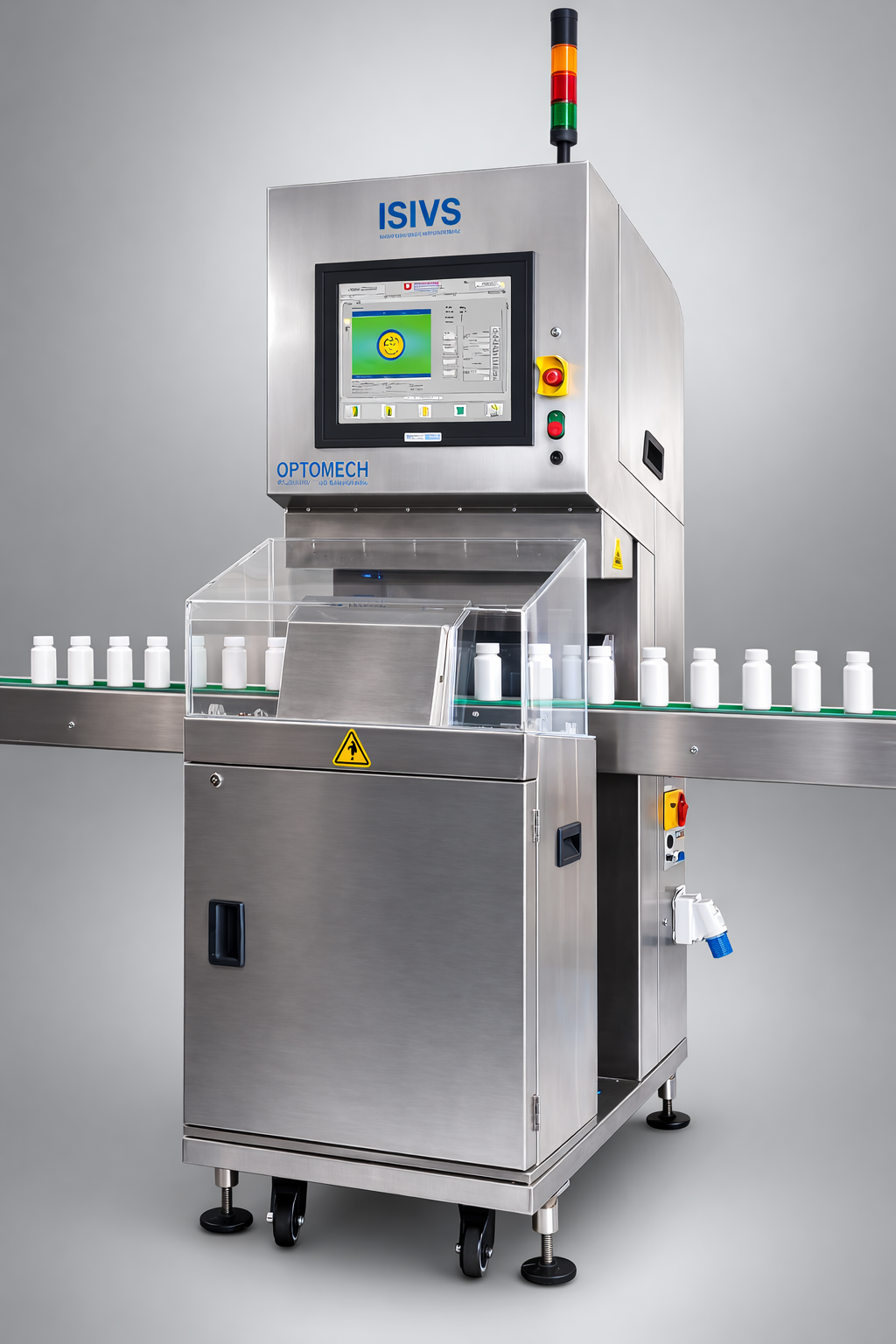
Optomech ISIVS XL Induction Sealing Integrity Verification System — inline thermal imaging inspection machine

A Single Defective Seal Can Cost You Everything

A good induction seal prevents product leakage, maintains product quality, provides tamper evidence, and protects shelf life. When a seal fails — and it does, on every production line — the consequences extend far beyond one bad bottle. With sampling inspection, those failures ship undetected.

🧪

Product Contamination & Spoilage

A loose cap or missing liner allows oxygen, moisture, and microbial contamination to enter. In pharmaceuticals, this directly threatens patient safety. In food and nutraceuticals, it accelerates degradation and eliminates shelf life. Regulatory agencies treat it as a critical defect — there is no acceptable threshold.

🏷️

Tamper-Evidence Failure

Induction seals are primary tamper-evidence for consumers. A bottle that passes through retail with a defective or missing foil seal looks like it has been opened — destroying consumer confidence and brand trust. In regulated markets, it is also a packaging non-compliance that can trigger FDA and regulatory action.

📦

Customer Returns & Recalls

Defective seals detected after distribution require expensive product recalls, damage brand reputation, and generate significant direct costs. Verified data from real packaging lines shows that even well-maintained induction sealers produce defective seals — from under-heating in cold start-up, liner material variation, and cap torque inconsistency.

📋

Regulatory Non-Compliance

For pharmaceutical manufacturers, induction seal integrity is a GMP requirement. US FDA, WHO-GMP, EU-GMP, and India's Schedule M all require documented evidence of packaging integrity. Sampling inspection does not provide per-bottle evidence. 100% ISIVS inspection with electronic records fulfils this requirement completely.

How ISIVS Works

See Through the Cap. Catch Every Defect.

The ISIVS inspection process is fully automatic and non-destructive. Bottles travel along the production conveyor and pass through the ISIVS unit without any interruption to line flow. The entire inspection cycle — from thermal image capture to pass/fail decision to physical ejection — completes in milliseconds.

1

Bottle Arrives on Conveyor

The induction-sealed bottle enters the ISIVS inspection zone on the production conveyor at full line speed. No manual placement required.

2

Thermal Camera Captures Seal Image

A highly sensitive cooled infrared thermal camera images the heat profile of the induction seal through the closed cap — completely non-contact and non-destructive.

3

Software Analyses the Heat Pattern

Advanced algorithms analyse the thermal image in real time. A correct seal produces a uniform ring pattern. Any deviation — weak bond, missing liner, loose cap, over/under heat — produces a characteristic defect signature.

4

Defective Bottle Automatically Ejected

Defective bottles are ejected from the line by a 2-way ejection mechanism — ensuring no defective product passes to the next stage. The defect image is stored in the database automatically.

Optomech ISIVS Induction Seal Integrity Verification System in operation on packaging line

Optomech ISIVS XL — inline thermal imaging inspection system for induction sealed bottles

Six Defect Types. All Caught. Every Bottle.

Each induction seal defect produces a unique and identifiable thermal signature. Optomech's advanced image analysis software is trained to recognise all six primary defect types, classify them correctly, and trigger immediate ejection — even at production speeds up to 250 bottles per minute.

🔴

Loose Cap

Cause: Capping machine / torque failure

The cap is not properly torqued onto the bottle neck. The induction seal is incomplete or asymmetric, creating a gap between the foil liner and the container mouth. Results in product leakage, contamination risk, and consumer tamper-evidence failure.

Thermal image: Irregular, off-centre heat ring with exposed edges
🔵

Under Heating

Cause: Induction sealer — insufficient power or speed too high

Insufficient induction energy is applied, resulting in a partially bonded or unbonded foil liner. The seal appears visually intact but has no bond strength. The bottle passes a visual check but will unseal with minimal force or during transit.

Thermal image: Cold blue pattern — insufficient heat transfer to liner
🟠

Over Heating

Cause: Induction sealer — excessive power or speed too low

Excessive induction energy burns through the foil liner or damages the container's neck finish, compromising the seal. Over-heated seals can create micro-pinholes in the foil, allowing slow leakage that is undetectable without thermal imaging.

Thermal image: Concentrated central hot spot — burnt liner pattern
✂️

Cut Liner

Cause: Raw material defect / liner damage

The aluminium foil liner inside the cap is physically cut or pierced — typically caused by a sharp edge on the capping equipment or a defect in the liner material. The cut creates a direct leak path through the seal regardless of how well the induction process performs.

Thermal image: Asymmetric pattern with visible break in the heat ring
🌙

Moon Cut

Cause: Partial liner damage / crescent-shaped tear

A crescent-shaped (moon-shaped) partial cut or tear in the foil liner, leaving part of the seal intact but creating a significant opening. Moon cuts are particularly difficult to detect visually, as the cap appears sealed from the outside. The ISIVS thermal image reveals the partial bond clearly.

Thermal image: Crescent-shaped cold zone on one side of the seal ring

No Liner

Cause: Missing liner in cap supply

The foil induction liner is completely absent from the cap. This occurs when the liner supply in the capping machine runs out or a liner is missing from the cap batch. The bottle has no seal whatsoever — the product is completely unprotected and the induction sealer simply heats an empty cap.

Thermal image: Solid cold blue — no heat transfer, no liner present
100% vs Sampling

Why Sampling is No Longer Sufficient

Sampling-based inspection (AQL) was designed for an era when 100% automated inspection was not possible. Today it is — and the packaging industry is moving rapidly toward mandatory 100% inspection, particularly in pharmaceuticals, nutraceuticals, and FMCG.

⚠️ Sampling Inspection (AQL)

  • Inspects 1–5% of bottles — 95%+ leave uninspected
  • Accepts a statistically calculated defect escape rate
  • Cannot catch single-bottle failures or short runs of defects
  • Results arrive after production — too late to adjust the sealer
  • No per-bottle traceability — only batch averages
  • Does not meet FDA 100% inspection expectations for critical packaging
  • Relies entirely on operator sampling consistency
  • Defective bottles can and do reach consumers and retailers

✅ 100% Inspection with ISIVS

  • Every single bottle inspected before it leaves the production line
  • Zero defective sealed bottles reach the market
  • Single-bottle failures caught immediately — even transient defects
  • Real-time feedback — sealer problems corrected before more defects occur
  • Per-bottle thermal image stored with timestamp for full traceability
  • 21 CFR Part 11 compliant electronic records for FDA audits
  • No operator involvement — fully automated, consistent every time
  • Eliminates seal-related returns, complaints, and recalls

Built for High-Speed Production. Designed for Zero Escapes.

The ISIVS is engineered from the ground up for continuous, unattended operation on high-speed packaging lines. Every design decision — from the stainless steel construction to the 2-way ejection mechanism — is driven by one objective: no defective bottle reaches the market.

🌡️

Cooled Infrared Thermal Imaging

Optomech ISIVS uses a highly sensitive cooled infrared thermal camera — not an uncooled bolometer sensor. Cooled detectors deliver significantly higher thermal sensitivity and sharper image contrast, enabling reliable detection of subtle seal defects that uncooled sensors miss entirely at production speeds.

🚀

Full Line Speed — No Slowdown

Inspection happens dynamically as bottles pass through the system. There is no bottle-stopping, no mechanical indexing, and no reduction in conveyor speed. The ISIVS integrates seamlessly with your existing production line conveyor and feeding wheel systems.

🔒

2-Way Ejection — Zero Escapes

A dual-mechanism ejection system ensures that every bottle identified as defective is physically removed from the production line. The ejection bin is equipped with level sensors — the line stops before a full bin causes ejected defectives to overflow back into the good product stream.

🏭

Stainless Steel Construction

All external parts are manufactured in stainless steel, meeting food-grade and pharmaceutical GMP facility requirements. The machine design facilitates easy cleaning and meets hygienic design standards for use in regulated manufacturing environments.

🖥️

17" Industrial Touch Screen

A large 17-inch industrial-grade touch screen provides a clear, ergonomic user interface for operators. The touchscreen displays live inspection results, the last 100 defect images with thermal views, and all system status — at a glance, without requiring specialist training to interpret.

🔄

Simple Product Changeover

Changing between product types is as simple as selecting the product name from the configured product list. All acceptance criteria, tolerances, and inspection parameters are stored per product. No mechanical adjustments required for changeover — minimal line downtime.

👥

Multi-Level Access Control

Three-level password-protected access control (Operator / Supervisor / Administrator) prevents unauthorised changes to inspection parameters, tolerance settings, or product configurations. All user actions are logged and reportable — a key requirement for 21 CFR Part 11 compliance.

🌐

Remote Online Support

Optomech provides remote online support for configuring new products, troubleshooting, and optimising inspection parameters. Remote access enables rapid response without waiting for an engineer site visit — minimising downtime and maximising system uptime.

📊

Real-Time Process Feedback

Beyond accept/reject, the ISIVS gives you actionable process intelligence. Trends in defect type — increasing under-heating, for example — indicate a developing problem in the induction sealer before it becomes critical. Catch and correct the root cause before defective production escalates.

Regulatory Compliance

Built for Pharmaceutical GMP. Ready for Your Audit.

Pharmaceutical and regulated nutraceutical manufacturers require more than inspection performance — they require documented evidence of system validation and regulatory compliance. The Optomech ISIVS is designed to meet these requirements out of the box.

📜

21 CFR Part 11 — Electronic Records & Signatures

The ISIVS software fully complies with US FDA 21 CFR Part 11, governing electronic records and electronic signatures in pharmaceutical manufacturing. This includes controlled access, audit trails, timestamped records, and the ability to generate reports that satisfy FDA inspection requirements. All inspection data constitutes validated electronic records.

🗂️

IQ / OQ / PQ Validation Documentation

Optomech provides complete Installation Qualification (IQ), Operational Qualification (OQ), and Performance Qualification (PQ) documentation. This is the standard pharmaceutical validation package required for all quality-critical equipment under FDA, WHO-GMP, EU-GMP, and India Schedule M GMP guidelines. Documentation is provided as part of the commissioning process.

🔐

Multi-Level Password Access & Audit Trail

All user interactions — logins, parameter changes, report generation, product selections — are logged with timestamp and user ID. The user access command log is exportable as a report. This provides a complete, tamper-evident audit trail of all system activity for regulatory inspections.

💾

Secure Data Storage & Recall

Every inspection result, along with the thermal image of each defective bottle, is stored in a secure database. Records can be recalled at any time for retrospective review — supporting batch release documentation, regulatory submissions, and customer quality audits. Data is never overwritten or deleted without authorisation.

Every Sector That Depends on Seal Integrity

Wherever induction sealing is used to protect product quality, prove tamper evidence, or meet regulatory requirements, the ISIVS delivers the inspection confidence that sampling simply cannot provide.

💊

Pharmaceuticals

Tablet bottles, capsule bottles, syrup bottles, and OTC medicines — all require 100% seal verification as part of GMP packaging quality assurance. The ISIVS provides per-bottle traceability, 21 CFR Part 11 records, and IQ/OQ/PQ documentation for regulatory submission.

GMP Compliant 21 CFR Part 11 IQ/OQ/PQ
🌿

Nutraceuticals & Dietary Supplements

Vitamins, minerals, protein powders, and health supplements in induction-sealed bottles. Consumers and regulatory bodies increasingly expect pharmaceutical-grade seal integrity for nutraceutical products. A failed seal in a premium supplement product destroys consumer trust.

Supplement Bottles Consumer Trust Shelf Life
🥗

Food & Condiments

Cooking oils, sauces, vinegars, honey, and other food products in induction-sealed bottles. Product contamination and leakage during transit are primary concerns. ISIVS ensures every food product sealed on the line meets integrity requirements before dispatch.

Food Safety Leak Prevention Transit Integrity
🌾

Agrochemicals & Pesticides

Pesticide and agrochemical bottles with induction seals require absolute seal integrity — not only to prevent product degradation, but because leakage of these products poses health and safety risks during transport and storage. Regulatory compliance for agrochemical packaging is strict.

Safety Critical Regulatory Compliance Leak Prevention
💄

Cosmetics & Personal Care

Shampoos, lotions, serums, and other cosmetic products in induction-sealed containers. Product leakage and seal failures damage premium brand perception and lead to consumer complaints. 100% seal inspection ensures every unit reaching retail shelves is product-perfect.

Premium Brand Tamper Evidence Retail Ready
🧴

Industrial Chemicals & Specialty Liquids

Adhesives, solvents, lubricants, and specialty chemicals in sealed containers. Seal failure in industrial chemical packaging creates handling hazards, product loss, and liability exposure. ISIVS provides continuous, unattended inspection on high-speed fill-and-seal lines.

Hazardous Materials High Speed Lines Liability Protection
Reporting & Data Intelligence

Beyond Pass/Fail — Actionable Data at Every Level

The ISIVS doesn't just catch defects — it generates the data intelligence your quality, operations, and regulatory teams need. Every inspection event is logged, analysed, and available for reporting from the moment it happens.

📺

Live Defect Dashboard — Last 100 Defects

The inspection screen continuously displays the last 100 detected defects with their thermal images, defect type classification, and timestamp. Operators can identify a developing problem pattern — such as a sudden increase in under-heating events — and alert the sealer operator immediately.

🗄️

Permanent Defect Image Database

Every defective bottle's thermal image is stored permanently in the database with metadata: product, batch, timestamp, defect type. Any stored image can be recalled at any future time — for batch investigations, customer complaints, regulatory inspections, or trend analysis across multiple production runs.

📈

Statistical Process Control (SPC) Reports

SPC reports aggregate inspection data over time to reveal sealing process trends. Rising defect rates of a particular type indicate that the induction sealer or capper requires attention before the process drifts out of control. Proactive maintenance driven by data — not reactive breakdown response.

📋

PDF & Excel Export — Automatic Scheduling

All reports are available in both PDF (for documentation and archiving) and Excel (for analysis and integration with quality management systems). Reports can also be automatically generated at predefined times — shift end, daily, weekly — and sent over the network to designated quality and management personnel.

🔑

User Access Command Log

Every user action — login, parameter change, product selection, report generation, tolerance adjustment — is recorded in a time-stamped access log. This tamper-evident audit trail is fully reportable and satisfies 21 CFR Part 11 user activity documentation requirements.

🌐

Network Report Distribution

The ISIVS can be configured to automatically generate an Excel report at a predefined time and send it over the facility network to designated recipients — quality managers, production supervisors, and site leadership — without any manual intervention. Paperless quality reporting built in.

India's Own. Built to Global Standards.

The Optomech ISIVS is designed, engineered, and manufactured in Hyderabad, India — by a company with over 40 years of experience in optical and vision inspection technology. It delivers globally competitive inspection performance with the support infrastructure of a local manufacturer.

🏭

Designed & Made in Hyderabad Since 1981

Optomech has manufactured quality inspection instruments in India since 1981. The ISIVS is built at our Kukatpally, Hyderabad facility with full in-house design, fabrication, software development, and testing — enabling rapid customisation and local after-sales support.

🌡️

Cooled Thermal Imaging — Superior Sensitivity

Unlike competitors using uncooled bolometer-type cameras, Optomech's ISIVS uses a highly sensitive cooled infrared detector. This delivers sharper, higher-contrast thermal images with significantly better sensitivity to subtle seal defects — especially under-heating and partial moon-cut defects at production speeds.

📋

Full Pharma Validation Package Included

Optomech provides complete IQ/OQ/PQ documentation as a standard deliverable — not an optional extra. This saves pharmaceutical manufacturers significant time and cost in preparing their own validation dossiers, and ensures the documentation is technically aligned with the actual installed system.

🔧

Onsite Installation, Training & Service

Optomech's team handles complete onsite installation, commissioning, and operator training. Ongoing service and support is available across India with remote online access for rapid troubleshooting. Service contact: Chinthaya · +91-9032364140

🎯

Trusted by Leading Pharma & FMCG Brands

Optomech ISIVS systems are in production use at Hetero, Strides Shasun, Gopaldas Visram, Gelcaps, SSF Plastics, and ALPLA — organisations with demanding quality standards and zero tolerance for packaging failures. Their operational trust is the strongest validation of the system.

📡

Remote Support & Rapid Commissioning

New products can be configured and validated remotely by Optomech engineers without requiring a site visit. This dramatically reduces changeover delays for new SKUs. Our average commissioning timeline from delivery to validated production operation is among the fastest in the industry.

Optomech ISIVS systems protect the packaging integrity of products from some of India's most trusted pharmaceutical, nutraceutical, and FMCG brands.

HETERO Strides Shasun Gopaldas Visram Pravesha Packaging Gelcaps SSF Plastics Shally Engineering ALPLA

Frequently Asked Questions

Everything packaging engineers, quality managers, and regulatory teams ask about induction seal inspection and the Optomech ISIVS.

What is an Induction Sealing Integrity Verification System (ISIVS)? +
An ISIVS is an inline machine vision inspection system that automatically verifies the integrity of every induction-sealed bottle on a packaging line. The Optomech ISIVS uses advanced cooled infrared thermal imaging to photograph the heat profile of each seal through the closed cap, without touching or opening the bottle. Sophisticated image analysis software evaluates every thermal image in real time, classifies any sealing defects, and triggers an automatic ejection mechanism to remove defective bottles from the production line — at full production speed.
How does infrared thermal imaging detect induction seal defects? +
Induction sealing heats the aluminium foil liner inside the cap. A correctly bonded seal produces a characteristic, uniform ring-shaped heat pattern on the thermal image — the heat of the bonding process is clearly visible to the infrared camera even through the plastic cap material. Defects alter this pattern in predictable ways: a missing liner appears as a cold blue image; under-heating shows an incomplete or cold ring; over-heating shows a concentrated hot spot; a loose cap creates an asymmetric pattern; and cut or moon-cut liners show breaks in the ring. The ISIVS software classifies each of these signatures automatically.
What seal defects does the Optomech ISIVS detect? +
The Optomech ISIVS detects six primary induction seal defect types: Loose Cap (improperly torqued cap), Under Heating (insufficient induction energy — seal not bonded), Over Heating (excessive induction energy — liner damaged), Cut Liner (foil liner physically cut or pierced), Moon Cut (crescent-shaped partial tear in the liner), and No Liner (foil liner completely absent from the cap). Each defect type produces a unique, identifiable thermal signature that the system's advanced software recognises and classifies in real time.
Is the ISIVS inspection non-destructive? Does it affect the product? +
Yes — completely non-destructive. The ISIVS thermal camera passively images the infrared energy (heat) already present in the seal from the induction sealing process. No energy is projected onto the product. The inspection camera does not touch the bottle or cap. The product inside is not affected in any way. Inspection is performed through the closed cap — no opening, no contact, no degradation. This is essential for pharmaceutical and food applications where product sterility and integrity must not be compromised by the inspection process itself.
Is the Optomech ISIVS 21 CFR Part 11 compliant? +
Yes. The ISIVS software fully complies with US FDA 21 CFR Part 11, which governs electronic records and electronic signatures in pharmaceutical manufacturing. Compliance features include: multi-level password-protected user access control; complete timestamped audit trail of all user actions; secure, non-modifiable electronic records for all inspection data; and the ability to generate compliant reports. Optomech also provides full IQ/OQ/PQ validation documentation to support pharmaceutical facility qualification requirements.
How is the ISIVS installed on a production line? +
The ISIVS is installed inline on your existing packaging line conveyor, positioned immediately after the induction sealing machine. Optomech engineers handle complete onsite installation and commissioning, including integration with your conveyor and feeding wheel systems, product configuration, tolerance setting for each product type, operator training, and IQ/OQ/PQ validation documentation. The system's stainless steel construction and modular design are suited to both new-line installations and retrofit of existing packaging lines.
How do I change over the ISIVS when changing bottle or product types? +
Changeover is as simple as selecting the new product name from the configured product list on the touchscreen. All inspection parameters, tolerances, and acceptance criteria for that product are stored in the system database and loaded instantly. There are no mechanical adjustments required for changeover between product types. New products can be added to the system database by supervisors or administrators, or configured remotely by Optomech engineers via remote access — minimising line downtime during product changeovers.
Which pharmaceutical and FMCG companies in India use Optomech ISIVS? +
Optomech ISIVS systems are in active production use at Hetero Pharma, Strides Shasun, Gopaldas Visram, Pravesha Packaging, Gelcaps, SSF Plastics, Shally Engineering Plastics, and ALPLA. These customers span pharmaceutical manufacturing, nutraceuticals, and FMCG packaging — organisations with demanding quality standards, FDA and GMP compliance requirements, and zero tolerance for packaging failures reaching consumers.
What reports does the ISIVS generate and in what formats? +
The ISIVS generates: a live defect dashboard showing the last 100 defects with thermal images; complete inspection data logs for every bottle; statistical process control (SPC) reports tracking defect trends over time; user access command logs for 21 CFR Part 11 audit trail; and full batch and shift inspection reports. All reports are available in both PDF and Excel formats. The system can be configured to automatically generate Excel reports at a predefined time and send them over the network — enabling paperless, automated quality reporting.
What is the difference between a cooled and uncooled infrared camera for seal inspection? +
Cooled infrared cameras use a cryogenic cooling mechanism (typically Stirling cooler) to reduce the detector temperature to near absolute zero. This dramatically improves the detector's sensitivity to small temperature differences — allowing detection of subtle heat variations that indicate partial seal defects like under-heating, moon cuts, and partial liner damage. Uncooled bolometer cameras are less expensive but have significantly lower thermal sensitivity and produce less detailed images at production speeds. Optomech's ISIVS uses a cooled detector for superior defect detection reliability — particularly for the subtler defect types that uncooled systems frequently miss.
Related Vision Inspection Systems

Complete Your Packaging Line Inspection

Stop Sampling. Start Knowing.

Every packaging line that uses induction sealing is producing some proportion of defective seals. The question is whether you catch them before they reach your customers. We'll show you exactly what ISIVS finds — on your product, on your line.

Request a Demonstration Talk to Our Engineers
Call: +91-9032364140  ·  Email: sales@optomech.in  ·  www.optomech.in