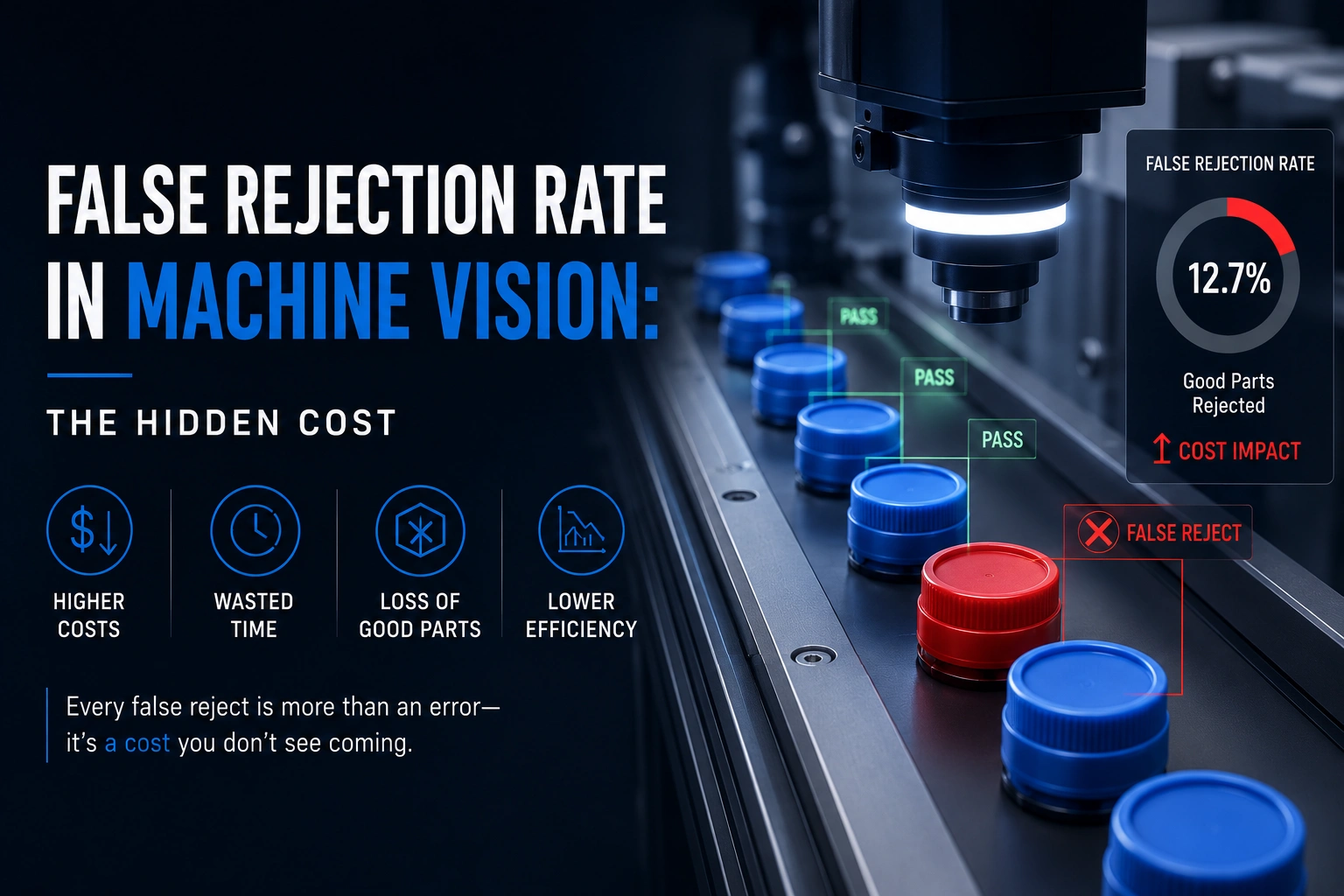
Machine vision adoption in Indian packaging plants has accelerated sharply over the last five years. Most plants now track how many defects their vision system catches. Very few track how many good products it rejects.
This is a problem. A false rejection rate of 3% on a line producing 50,000 units per day means 1,500 perfectly good bottles, caps, or packs going into the waste stream every day. That's not a quality win — it's a production loss with a quality label on it.
What False Rejection Rate Actually Means
False rejection rate (FRR) — also called false positive rate or false alarm rate — is the proportion of conforming units that a vision system incorrectly flags and rejects. It's distinct from the miss rate, which measures defects the system fails to catch.
Both are failure modes, but they have different costs. A high miss rate risks customer complaints, recalls, and regulatory action. A high false rejection rate causes production losses, operator fatigue, and — critically — it erodes operator trust in the system until they start bypassing it. At that point, you have neither quality protection nor throughput.
In our experience across pharma and FMCG packaging lines, vision systems with persistent false rejection rates above 2–3% are routinely bypassed by operators during peak production hours. The bypass is usually informal — operators override the reject gate, switch to manual inspection mode, or flag the inspection station as "under maintenance." The system is running but not functioning. This happens far more often than plant managers realise, because it isn't reported.
How to Measure Your Current False Rejection Rate
Most plants assume they know their FRR — they don't. The typical mistake is equating total rejections with defect catches. The actual measurement requires checking what's in the reject bin.
The Audit Method (Works on Any System)
-
Collect a timed reject sample
Run the line for a defined period — typically one shift — and collect all units that the vision system rejected into a separate, labelled bin. Record the total units inspected during that period.
-
Manually inspect every rejected unit
Have a trained QA inspector examine each rejected unit and classify it as: genuinely defective, or conforming (falsely rejected). This is the only reliable way to separate the two populations.
-
Calculate FRR
FRR = (Number of conforming units in reject bin ÷ Total units inspected) × 100. For example: 300 conforming units in the reject bin from a 10,000-unit run = 3.0% FRR.
-
Log the defect type for false rejects
For each falsely rejected unit, note what the vision system likely reacted to — label position, fill level shadow, cap colour variation, surface reflection. This data drives the diagnostic step.
If your vision system stores rejection images (most modern systems do), you can perform much of this analysis directly from the system log without pulling physical samples — faster, and more representative of performance across product variations.
Is Your Vision System Producing Too Many False Rejects?
Optomech's applications team can review your rejection log data and system configuration remotely. In most cases, the diagnosis and fix are achievable without a site visit.
The 6 Most Common Causes of High False Rejection Rate
Understanding why FRR is high determines whether it's a configuration fix or something structural. Most high-FRR cases fall into one of these categories:
| Cause | How It Appears | Typical Fix |
|---|---|---|
| Ambient light variation | FRR spikes at certain times of day or seasons — windows, skylight changes | Install light shields or recalibrate reference images across ambient conditions |
| Lamp aging / intensity drift | FRR increases gradually over months without other changes | Recalibrate reference at current lamp intensity; replace lamp if intensity fallen >15% |
| Product variation outside training set | FRR spikes when new label batch, container batch, or fill colour runs | Retrain model on representative samples from actual production variation range |
| Tolerance thresholds set too tight | High FRR from day of commissioning; operator complaints immediately | Statistical threshold adjustment using production sample data; document new thresholds |
| Conveyor vibration causing blur | Rejection images show motion blur; FRR worse at higher line speeds | Reduce trigger delay, increase strobe intensity, investigate conveyor mechanicals |
| Camera / lens contamination | FRR increases suddenly; rejection images show consistent dark region | Clean lens and camera window; schedule periodic preventive cleaning |
What Most People Get Wrong About Machine Vision False Rejects
The standard response to a high false rejection rate is to loosen the inspection tolerances — widen the pass/fail threshold until the rejects drop. This works in the short term but creates a structural problem: the system is now less sensitive to real defects, and nobody quantified by how much.
The correct approach is to diagnose the root cause before touching the thresholds. If false rejects are caused by lighting variation, fixing the lighting reduces FRR without changing detection sensitivity at all — you get both better throughput and better defect detection. Threshold relaxation sacrifices one for the other.
The second misconception is that high FRR is a sign of a "sensitive" system — that it's catching more defects. That's occasionally true but usually not. High FRR more commonly indicates the system is reacting to noise — variation in the inspection environment — rather than to genuine defects in the product. A well-tuned vision system should be sensitive to defects and insensitive to everything else.
If your supplier's solution to every high-FRR complaint is to loosen tolerances, ask them to show you the resulting miss rate data. Widening thresholds reduces false rejects but also reduces detection sensitivity. Without measuring both simultaneously, you're trading one quality failure mode for another — and you won't discover the trade-off until a customer complaint arrives.
How FRR Varies by Inspection Type
Not all vision inspection stations carry the same FRR risk. Understanding which stations are most prone to false rejects helps prioritise where to focus diagnostic effort.
Fill Level Inspection
Fill level inspection is one of the most challenging stations for FRR control. Fill level measurement is sensitive to meniscus shape (which varies with product viscosity, temperature, and fill speed), foam presence immediately post-fill, container orientation variation, and label reflections at the liquid surface. A well-designed system uses a telecentric camera angle, diffuse backlighting, and a time delay to allow foam to settle — but FRR can still run 0.5–2% in difficult product categories.
Cap Presence and Seating Angle
Cap inspection is generally the most stable station. Cap presence is binary, cap colour variation is limited, and mechanical capping systems produce consistent cap geometry. FRR in cap inspection below 0.3% is achievable and expected from a well-integrated system. High FRR at the cap station almost always indicates a camera height or field-of-view alignment issue.
Label Position and Print Verification
Label inspection FRR depends heavily on label material and print consistency. Metallic labels, transparent labels, and labels with complex artwork near the position measurement zone all create higher-than-average FRR risk. Label wrinkle variation from the labelling machine — which is a mechanical issue, not a label defect — is a common false reject trigger that operators and suppliers often confuse.
Induction Seal Inspection
Induction seal inspection using thermal imaging or vision-based methods has low inherent FRR when correctly configured. Thermal imaging in particular is less sensitive to ambient light and container surface variation. If FRR is high at an induction seal station, the usual causes are trigger timing (imaging before the seal has cooled to a stable thermal signature) or container rotation during conveying.
Practical Takeaway
Start by measuring your actual false rejection rate — not estimated, measured. Run the one-shift audit, classify the reject bin contents, and calculate the number. If it's above 1%, investigate the root cause before touching any thresholds.
If it's above 2%, treat it as a production problem, not a quality problem. At that level, the financial loss from falsely rejected good product and the operator bypass risk are both significant enough to justify dedicated corrective action — whether that's a lighting recalibration, a model retrain, or a system engineering review.
A well-engineered machine vision system running at 0.1–0.5% FRR gives you both quality protection and full production throughput. That's the benchmark worth targeting.
Before calling your vision supplier: (1) Check rejection images — are the falsely rejected units visually conforming? (2) Check if FRR spikes at specific times of day → lighting issue. (3) Check if FRR increased after a material or label batch change → training set issue. (4) Check if FRR has been increasing gradually over months → lamp aging or contamination. (5) Check line speed at time of high FRR → trigger timing or blur issue. Four out of five high-FRR cases are diagnosable from these five checks alone.