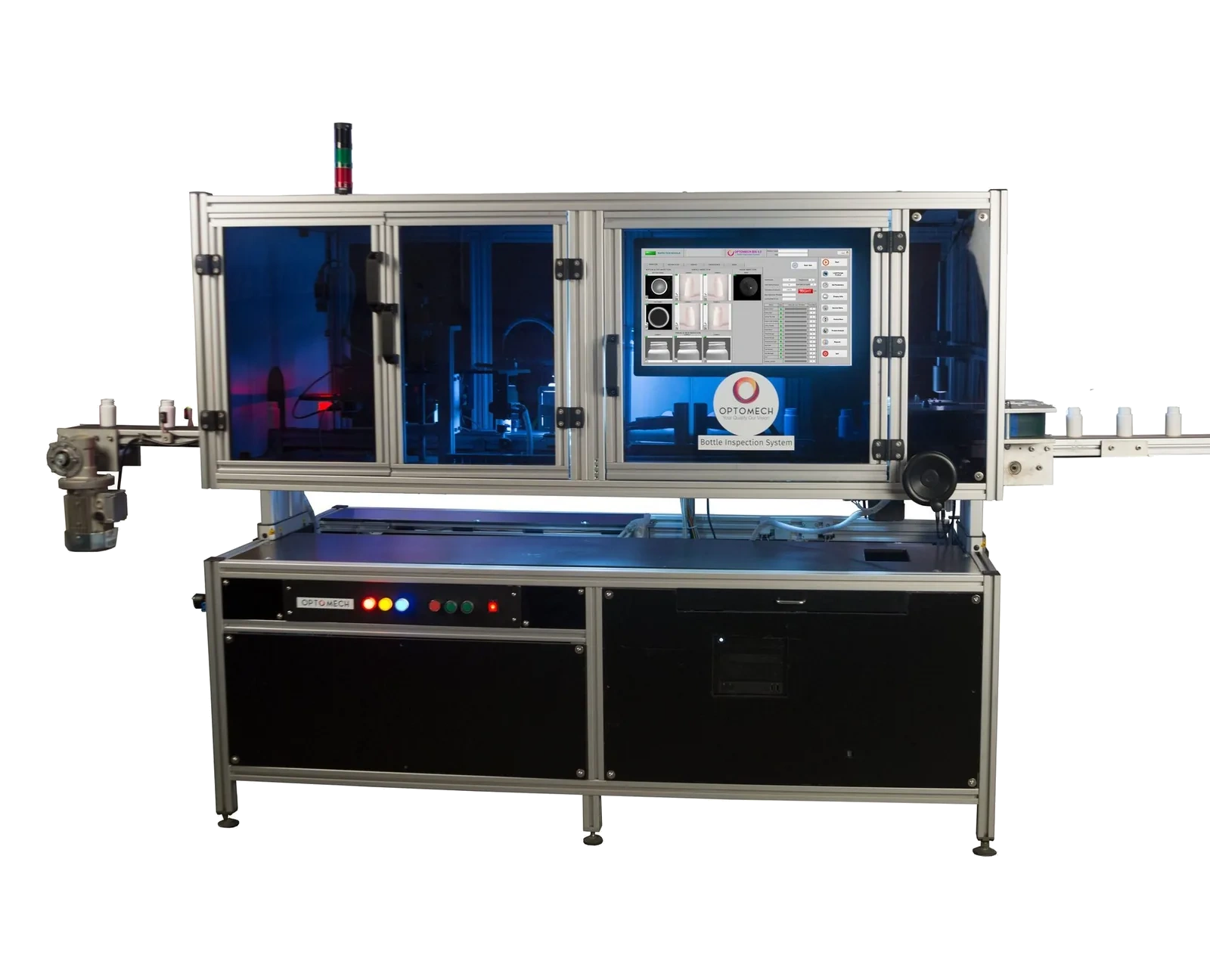
Looking for an empty bottle inspection machine? At Optomech, empty bottle inspection is done by the Bottle Inspection System (BIS). This guide explains the defects themselves. The BIS page covers the machines, speeds and variants.
Why Inspect Bottles Before Filling?
Moulding, handling, storage and transport can all damage or contaminate a container. Once a bottle is filled, capped and labelled, a defect costs more: product, cap, label and line time are all lost, and if the defect escapes, a complaint or recall can follow. Manual inspection at line speed is tiring, and it struggles with small defects on the sealing surface or inside the bottle. 100% vision inspection before filling turns those risks into rejected empty containers. You can also trace the defect data back to the moulding process.
The Six Inspection Zones
A bottle is inspected as separate zones because each one needs its own viewing angle and lighting. The BIS organises inspection into six zones:
1. Sidewall
Typical defects: scratches, black marks and specks, dents, deformation, contamination embedded in the wall, colour variation, weld lines and sink marks.
Why they happen: degraded resin or carbon specks from the extruder, contaminated regrind, uneven parison or preform heating, mould surface issues, and handling damage after moulding.
How vision finds them: on translucent containers, transmitted (back) lighting shows dark specks and thickness variation as contrast changes. Reflected and angled lighting shows scratches, dents and surface marks. Several cameras around the bottle cover the full circumference.
2. Base
Typical defects: spot defects, thin wall, pinholes, unfilled areas, sink marks, non-uniform thickness and gate-mark issues.
Why they happen: material distribution problems at the base, poor pinch-off on extrusion blow-moulded bottles, gate issues on injection-moulded preforms, and cooling problems.
How vision finds them: a camera looking up through the base, with lighting chosen to show thickness and holes. A thin or pin-holed base is a strength and leak risk, especially on heavier fills.
3. Neck finish
Typical defects: chipped neck, thread damage, short shot, warpage, flash, neck deformation and ovality.
Why they happen: incomplete filling of the neck mould, worn or misaligned tooling, trimming problems, and deformation while the plastic is still warm.
How vision finds them: combined top and side views, with lighting that makes flash and chips stand out against the neck profile. Ovality and diameter checks compare the measured neck geometry with tolerance limits. Neck defects matter because the cap has to seat and torque correctly.
4. Sealing surface
Typical defects: a surface that isn't flat, contamination or powder on the lip, surface damage, unevenness, cuts, flash and finish defects.
Why they happen: trimming and deflashing, damage during handling and conveying, and contamination from the moulding area or storage.
How vision finds them: top-view macro optics with ring or low-angle lighting that highlights breaks in the sealing land. This zone matters a great deal because the liner or induction seal bonds here. A nick or bump can become a leak path even when the cap is torqued correctly. Optomech's BIS-SC is dedicated to this zone.
5. Shoulder
Typical defects: distortion, contamination, surface defects and weld marks.
Why they happen: uneven material distribution where the wall transitions to the neck, and mould parting-line issues.
How vision finds them: angled side cameras. The shoulder is curved and easily missed by straight sidewall views.
6. Inside
Typical defects: extra material, contamination, dark patches, foreign particles and interior streaks.
Why they happen: particles entering during moulding, storage or transport (open containers, damaged liners in shipping cartons), and degraded material on inner surfaces.
How vision finds them: a camera looking into the container through the neck, often with coaxial lighting. Narrow necks, such as eye-dropper bottles, need special optics. See BIS-EDB.
Quick Reference: Zone, Defect, Risk
| Zone | Example defects | Main risk if missed | Typical view |
|---|---|---|---|
| Sidewall | Black specks, contamination, dents, thin areas | Contamination complaint, appearance, weak wall | Wrap-around side cameras |
| Base | Thin base, pinholes, unfilled areas | Leaks, splits under load | Upward-looking camera |
| Neck finish | Chips, flash, short shot, ovality | Poor cap seating, leaks, torque failures | Top and side views |
| Sealing surface | Cuts, unevenness, powder on lip | Seal failure, leakers | Top-view macro optics |
| Shoulder | Distortion, weld marks | Appearance, label application issues | Angled side cameras |
| Inside | Foreign particles, extra material | Product contamination | Inside view through the neck |
Classifying Defects: Critical, Major, Minor
Not every defect justifies the same reject sensitivity. Agree a classification with QA and record it in your URS:
- Critical: likely to cause product contamination, leaks or seal failure, for example foreign particles inside, sealing-surface cuts or pinholes.
- Major: likely to cause a functional problem or complaint, for example neck ovality, a thin wall or a heavy flash.
- Minor: cosmetic only, for example light scratches or slight colour variation, depending on your product and market.
Set sensitivity by class, then balance detection against false rejects. See false rejection rate in machine vision.
Build a Defect Library Before You Buy
- Collect real defective bottles from moulding and filling rejects, labelled by zone and defect type
- Include borderline samples just inside and just outside your acceptance limits
- Cover every container size, colour and material you run (HDPE, PET, PP, LDPE)
- Keep a set of good bottles to measure false rejects
- Store the library under control, because you will need it again for FAT, OQ/PQ and routine challenge tests
Choosing the Right BIS Variant
| Variant | Focus | Published highlights |
|---|---|---|
| BIS-XL | Multi-zone flagship | Up to 10,000 bph; 6 zones; 30 ml – 5 L; HDPE, PET, PP, LDPE |
| BIS STD+ | Agrochemical HDPE bottles | Up to 7,200 bph; 4 zones |
| BIS-EDB | Eye-dropper bottles | Inside contamination and sealing-surface defects on small-neck containers |
| BIS-SC | Sealing surface | Up to 7,000 bph; 0.2 mm; flash, cuts, powder on lip |
For Optomech starting-from price bands, see the vision inspection price guide. For pharma lines, also read the revised Schedule M packaging checklist.